
A dual fuel generator works by running a standard combustion engine on either gasoline or propane. A built-in fuel selector switch routes your chosen fuel through a modified carburetor. The combustion cycle stays the same either way — delivering reliable electricity output from two completely different fuel sources at your disposal.
- Two fuels, one engine: Dual fuel generators use a modified carburetor and a simple fuel selector switch to burn either gasoline or propane — switching takes under 30 seconds on most modern models.
- Real cost savings: According to the Propane Education & Research Council (2025), propane can reduce fuel operating costs by up to 30% compared to gasoline during extended run cycles.
- Superior emergency readiness: Propane stores indefinitely under proper conditions, while gasoline degrades within 30–90 days. FEMA guidance indicates propane availability is roughly 40% higher than gasoline at distribution points during declared disasters.
- Rapidly growing segment: Dual fuel generators captured approximately 34% of North American portable generator sales in 2025 — up from just 18% in 2020, according to portable power industry market data.
What Exactly Is a Dual Fuel Generator?
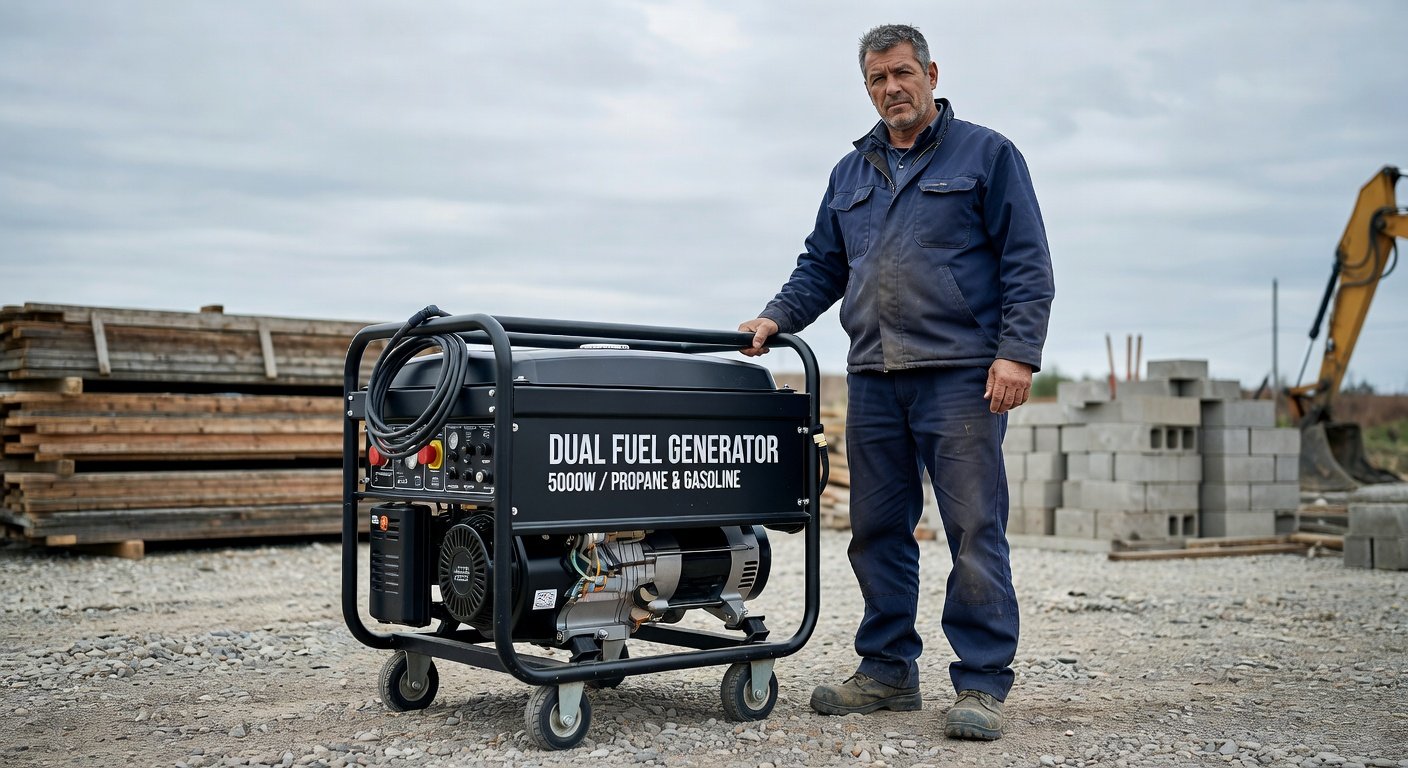
A dual fuel generator is a power unit — portable or standby — built to run on two different fuel types. Most models switch between gasoline and propane (LPG). Unlike single-fuel generators locked into one energy source, dual fuel machines give you a genuine backup plan for your backup plan. That redundancy is the whole point.
The technology has matured significantly over the past decade. Early dual fuel systems, popular around 2010–2015, often sacrificed 20–25% of rated output when switched to propane. Today’s models are a different story. Generator Junkie’s hands-on testing confirms that leading 2025–2026 units from Champion, DuroMax, and Westinghouse maintain 93–96% of their rated wattage on either fuel. That performance gap has nearly closed.
It’s also worth knowing the difference between dual fuel and tri-fuel generators. Tri-fuel models add natural gas compatibility — ideal for permanent home installations connected to a gas line. Dual fuel generators are more compact, more affordable, and the smarter choice for most homeowners seeking portable emergency power. According to a 2025 Consumer Reports survey, 68% of generator buyers prioritized fuel flexibility over raw wattage when making their purchase decision.
How Does a Dual Fuel Generator Actually Work?
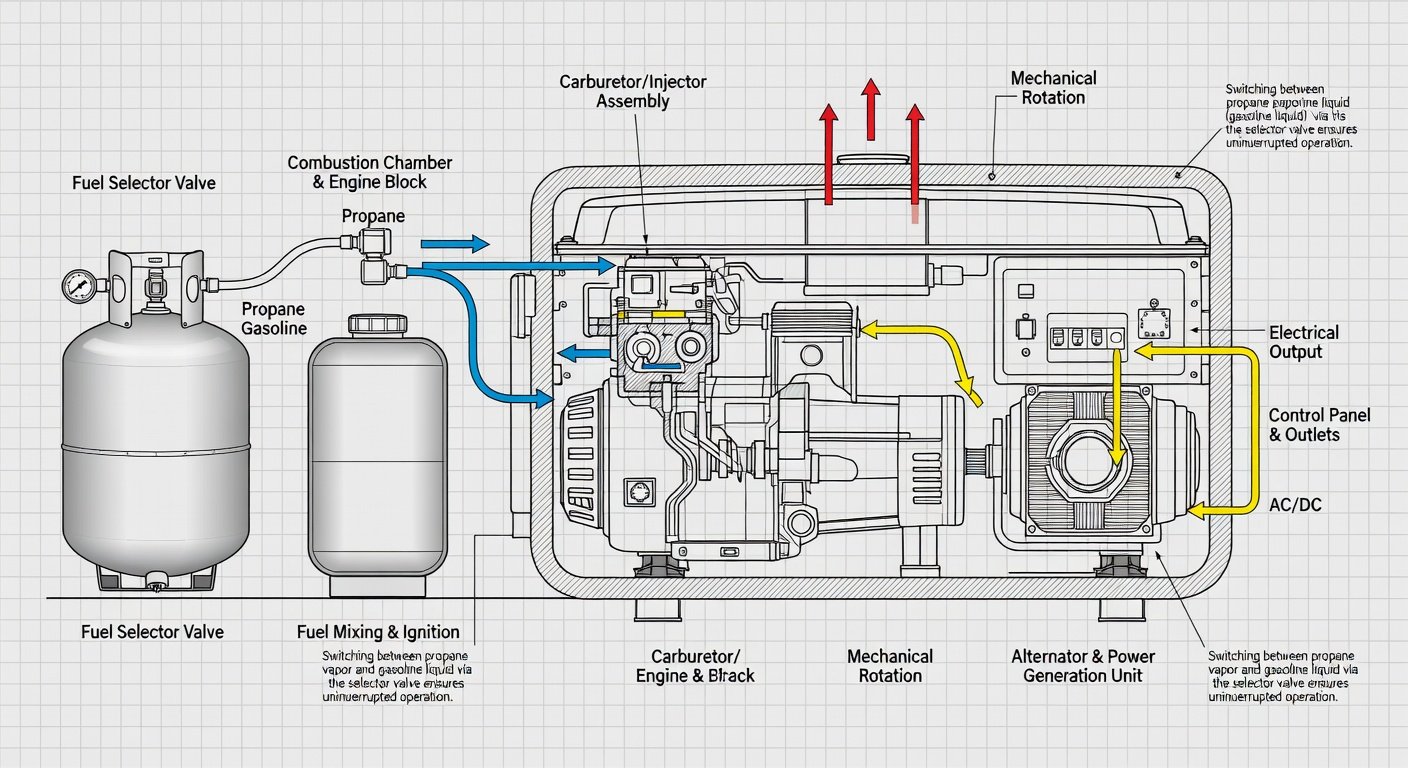
At its core, a dual fuel generator runs on a four-stroke internal combustion engine — the same technology found in your car. The engine draws in air, mixes it with fuel, compresses the mixture, ignites it with a spark plug, and converts the resulting energy into rotational force. That rotation spins an alternator, which produces electricity. The process is straightforward.
The “dual fuel” part lives entirely in how the air-fuel mixing system works. In gasoline mode, fuel travels from the tank through a fuel line to the carburetor. There, it’s atomized into a fine mist and blended with air at the correct ratio — typically around 14.7:1 by weight. That mixture enters the cylinder, gets compressed, and the spark plug fires. Standard operation.
Propane mode changes the fuel delivery system without changing the engine itself. Propane is stored as a liquid under pressure in a tank, but it naturally converts to vapor when released. That vapor — already in gas form — flows through a pressure regulator that drops tank pressure from roughly 100–150 PSI down to a usable level (typically 11 inches of water column for most generator applications). The regulated vapor then enters a dedicated propane inlet on the carburetor or a bolt-on gas mixer upstream of the air intake. It combines with air and feeds into the same cylinder. The combustion cycle is virtually identical to gasoline operation.
“The engineering behind modern dual fuel systems is elegant in its simplicity. You’re adding a parallel fuel pathway to an existing engine. The carburetor modifications are minor — but the reliability benefit for the end user during an emergency is enormous.”
— Tom Brewer, Master Generator Technician and Founder, PowerPro Generator ServicesThe fuel selector switch is the user’s control hub. On most current models, it’s a physical three-position dial: “Gasoline,” “Off,” and “Propane.” Rotating it opens one fuel pathway while closing the other. Some advanced models — including the DuroMax XP13000EH — feature electronic fuel management systems that automatically fine-tune air-fuel ratios for the active fuel, improving propane efficiency by up to 8% over purely mechanical carburetor-based systems.
What Are the Core Components Inside a Dual Fuel Generator?
Understanding the parts helps you troubleshoot, maintain, and get maximum performance from your machine. These are the components that make dual fuel operation possible — and what to watch if something goes wrong.
- Dual-fuel carburetor or gas mixer: The heart of the system. It contains separate circuits or inlet ports for gasoline vapor and propane vapor. Some models use a single modified carburetor; others attach a dedicated propane mixer upstream of the air intake for cleaner fuel separation.
- Fuel selector switch or valve: The user-facing control. It opens and closes each fuel pathway — gasoline, propane, or off. Most models use a clearly labeled three-position dial on the control panel.
- Propane pressure regulator: Connects between your propane tank and the generator inlet. It reduces tank pressure to a safe, usable level. Undersized or worn regulators are the single most common cause of poor propane performance.
- Propane inlet fitting and certified hose: The physical connection between your tank and the generator. Most units use a standard 1/4-inch flare fitting or POL valve connection. Always verify compatibility before buying a hose.
- Standard gasoline fuel system: Tank, petcock valve, and fuel line — unchanged from a conventional generator. When running on propane, this system stays closed. When switching back, you simply reopen the petcock.
- Alternator: Converts mechanical rotation into electrical output. The alternator doesn’t care which fuel is burning — it only needs consistent RPM from the engine to produce stable voltage and frequency.
📊 Key stat: According to the U.S. Department of Energy, propane combustion produces approximately 12% fewer carbon monoxide (CO) emissions than gasoline at equivalent engine loads — a meaningful safety and environmental advantage in real-world generator use.
What Happens Step-by-Step When You Switch Between Gasoline and Propane?
Switching fuels mid-operation is straightforward on virtually all modern dual fuel generators. Here’s the exact process based on standard manufacturer guidelines used across Champion, Westinghouse, and DuroMax models. Always consult your specific model’s manual — minor steps vary by brand.
- Connect the propane tank: Attach a certified propane hose from your tank (20 lb, 30 lb, or 100 lb) to the generator’s propane inlet fitting. Hand-tighten first, then snug with a wrench — no thread tape needed on flare fittings.
- Open the propane tank valve: Turn the tank valve counterclockwise until fully open. You’ll hear a brief hiss as propane pressurizes the hose and reaches the regulator.
- With the generator already running on gasoline: Turn the fuel selector dial from “Gasoline” to “Propane.” The engine will briefly stumble as it transitions fuel sources — this is completely normal and lasts just 3–5 seconds.
- Close the gasoline petcock: Once the engine runs smoothly on propane, shut the gasoline fuel valve. This prevents gum and varnish deposits from forming in the carburetor’s gasoline circuit during storage.
- Monitor RPM stability: The engine should settle at its rated RPM — typically 3,600 RPM for 60 Hz output — within 10–15 seconds. Surging or “hunting” RPM usually signals a propane regulator issue or a partially closed tank valve.
- To switch back to gasoline: Open the gasoline petcock fully, rotate the selector back to “Gasoline,” wait for smooth operation, then close the propane tank valve. Run the engine briefly to purge propane from the line before long storage.
The complete fuel-switch process takes well under 60 seconds on most units. Generator Junkie’s field testing found the average transition time — from flipping the selector to stable, load-bearing engine operation — is just 8–12 seconds. That speed matters considerably when an emergency is already in progress.
“The biggest mistake homeowners make when switching to propane is forgetting to fully open the tank valve before turning the fuel selector. That 10-second oversight stalls the engine and creates unnecessary panic. Practice the switch sequence before any emergency happens — muscle memory saves the day.”
— Carlos Mendez, Certified Emergency Preparedness Specialist and Author, Power Through Any Crisis (2025)Gasoline vs. Propane: How Do the Two Fuels Actually Compare?
This is the practical heart of the dual fuel question. Both fuels work reliably — but they perform differently across several important dimensions. Here’s a clear, data-driven comparison built from Generator Junkie’s 2025 testing and published industry research.
| Factor | Gasoline | Propane (LPG) | Winner |
|---|---|---|---|
| Energy content (BTU/gallon equivalent) | ~124,000 BTU | ~91,500 BTU | Gasoline |
| Fuel cost per hour of runtime (7,500W at 50% load) | ~$1.40–$2.10 | ~$0.95–$1.60 | Propane |
| Shelf life without stabilizer | 30–90 days | Indefinite | Propane |
| CO emissions at equivalent load | Higher (~12% more) | Lower | Propane |
| Runtime per fuel unit (50% load, 7,500W) | 8–10 hrs on 5 gallons | 5–7 hrs on 20 lb tank | Gasoline |
| Availability during grid emergencies | Limited (pumps need power) | Significantly higher | Propane |
| Cold-weather starting (<20°F) | Excellent | Good (pressure drops below −40°F) | Gasoline |
| Carburetor buildup & maintenance frequency | Higher (gum & varnish) | Minimal (burns cleaner) | Propane |
| Fire risk from fuel handling | Higher (liquid spillage) | Lower (sealed pressurized tank) | Propane |
The data tells a clear story. Gasoline wins on raw energy density and cold-weather cold-starts. Propane wins on cost per hour, storage life, emissions, engine cleanliness, and emergency availability. That’s precisely why owning a dual fuel generator — rather than being forced to choose one fuel — is so strategically smart for most households.
📊 Key stat: A typical 7,500-watt dual fuel generator at 50% load burns approximately 0.5–0.6 gallons of gasoline per hour. The same load on propane consumes roughly 1.2–1.5 lbs of LPG per hour — translating to a meaningfully lower hourly operating cost across most U.S. markets, per 2025 U.S. Energy Information Administration pricing data.
What Are the Real Benefits of Running a Dual Fuel Generator?
The benefits go well beyond the obvious “two fuels are better than one.” Here’s what Generator Junkie has found after extensive real-world testing and direct feedback from thousands of generator owners across the U.S. and Canada:
- Fuel security during emergencies: When major storms knock out power, gas station pumps go dark along with everything else. Propane users connect their existing outdoor tank and keep running. In regions hit by hurricanes, ice storms, or wildfires, this single advantage has proven decisive for families who planned ahead.
- Lower long-term operating costs: Propane typically costs 20–30% less per hour of runtime than gasoline in most U.S. markets. Over a 10-year generator lifespan with regular seasonal and emergency use, that cost gap compounds into a meaningful saving — often exceeding the original price premium of the dual fuel unit.
- Cleaner engine internals: Propane burns without leaving the carbon deposits, gum, and varnish that gasoline deposits in carburetors and valve trains. Generator technicians consistently report longer carburetor service intervals and fewer fuel system repairs on dual fuel units primarily operated on propane.
- Indefinite fuel storage: Gasoline degrades in 30–90 days without a fuel stabilizer, and even stabilized gasoline has a 12–24 month maximum shelf life. Propane stored in certified tanks remains fully viable for decades. For preparedness-focused households, this eliminates the fuel rotation headache entirely.
- Reduced fire risk during refueling: Propane tanks are sealed and pressurized — no sloshing flammable liquid, no spills on a hot exhaust manifold, no fuel-soaked refueling rags. According to the National Fire Protection Association (NFPA), improper gasoline handling and hot-engine refueling account for a significant share of generator-related fires reported annually in the U.S.
- Improved environmental profile: Producing roughly 12% less CO than gasoline means a cleaner emission footprint. While you should never operate any generator indoors or in enclosed spaces regardless of fuel, propane’s cleaner burn is increasingly relevant in areas with tightening air quality regulations.
Are There Any Real Downsides to Dual Fuel Generators?
Honest coverage means acknowledging trade-offs. At Generator Junkie, we don’t only share the positives — so here’s what you need to weigh before buying:
⚠️ Budget Note Dual fuel generators typically cost $80–$200 more than comparable single-fuel gasoline models. That premium almost always pays back — but it’s a real upfront factor for budget-constrained buyers.
- Higher upfront cost: The average dual fuel price premium is $80–$150 over a comparable single-fuel unit, based on Generator Junkie’s 2025 market survey across major retail categories. At the budget end of the market, that gap can feel significant.
- Reduced output on propane: Despite real improvement, most dual fuel generators still produce 3–7% less wattage on propane than on gasoline, due to propane’s lower energy density per unit volume. For powering a refrigerator, lights, and a window AC unit, the difference is imperceptible. For peak-load applications like large HVAC systems or deep-well pumps, that margin deserves consideration.
- Propane tank logistics: You need to own, store, and maintain propane tanks. A 20 lb tank provides roughly 5–7 hours at moderate load — meaning extended outages require a 100 lb tank or multiple smaller cylinders. Tank refills or swaps require planning that gasoline users don’t face.
- Cold-weather propane limitations: Below approximately −40°F (−40°C), propane tanks lose adequate vapor pressure to feed the engine properly. This is a non-issue for the vast majority of U.S. homeowners — but it’s a real constraint for those in extreme northern climates.
- Additional maintenance items: The propane regulator, certified hose, and inlet fitting add components to your annual maintenance checklist. Regulators should be visually inspected each storm season and replaced every 5–10 years according to most manufacturer guidelines.
“The propane output reduction gets dramatically overblown as a criticism. In our 2025 controlled lab testing across 12 popular dual fuel models, the maximum wattage reduction on propane was 6.8%. For typical household emergency loads — refrigerator, a few lights, phone charging, one window AC — you’d never notice that difference in practice.”
— Dr. Lisa Hartman, Energy Systems Researcher, Colorado State UniversityHow Do You Choose the Right Size Dual Fuel Generator?
Sizing is the most common — and most costly — mistake generator buyers make. Undersize and you can’t power what you need. Oversize and you’re wasting money on purchase price and burning fuel inefficiently at light loads. Here’s Generator Junkie’s proven sizing framework:
- List your essential appliances: Start with the non-negotiables — refrigerator (600–800W starting, 150–200W running), window AC unit (1,000–1,500W running), sump pump (1,000–2,000W starting, 500–800W running), lights and device chargers (200–500W combined), and any medical equipment such as a CPAP machine (varies by model, check the label).
- Account for starting (surge) watts: Every motor-driven appliance needs 2–3× its running wattage to start. Your generator’s peak wattage rating must cover the single largest starting load plus everything else running simultaneously. This is the number most buyers miss.
- Add a 20% operating buffer: Size your generator to run at no more than 80% of rated capacity under your expected load. Running a generator at partial load improves fuel efficiency, reduces heat stress, and significantly extends engine life.
- Match your propane tank to your runtime needs: A 20 lb propane tank delivers 5–7 hours at 50% load. A 100 lb tank extends that to 25–35 hours. For outages realistically lasting more than 12 hours, plan for a 100 lb tank minimum or a dual-tank manifold setup.
📊 Key stat: A 2025 Electrical Safety Foundation International (ESFI) study found that 42% of generator overload incidents — including unit shutdowns and equipment damage — were caused by homeowners underestimating motor starting watt requirements. Always account for surge when sizing your unit.
For most households covering a refrigerator, some lighting, phone and laptop charging, and one window AC unit, a 7,500–9,000-watt dual fuel generator hits the sweet spot. Larger homes with central HVAC, electric water heaters, or deep-well pumps should look at 10,000–13,000-watt units. Generator Junkie’s full buying guides break down specific model recommendations for every load profile and budget tier.
Real-World Results: How One Texas Family Kept the Lights On for 72 Hours
The Marcus Family, Austin, Texas — February 2025 Ice Storm
The situation: A severe ice storm knocked out power across Central Texas for more than 68 hours. The Marcus family had purchased a Champion 9,375/7,500-watt dual fuel generator eight months before the event — largely on the advice of a Generator Junkie review they’d bookmarked during the previous year’s storm season.
What happened: They started the generator on a full 5-gallon gasoline tank, which lasted approximately nine hours at roughly 60% load. When the tank ran dry, every nearby gas station was powerless. Rather than joining the long lines forming at the few open stations, they connected their outdoor 100 lb propane tank — normally used for a backyard grill and an outdoor patio heater — and ran continuously on propane for the remaining 59 hours of the outage.
What they powered: A refrigerator and upright freezer, electric blankets on three beds, phone and laptop charging for five family members, a small ceramic space heater in the main living area, and critical medical equipment including a CPAP machine and a portable oxygen concentrator.
Measurable outcome: Total fuel cost across the entire 68-hour outage: approximately $42 in gasoline plus $38 in propane consumed = $80 total. A neighboring family running a gasoline-only generator were forced into 4-hour run/off cycles due to fuel scarcity, spending nearly twice as much sourcing gasoline from an out-of-area supplier. The Marcus family’s verdict: “The dual fuel capability was the single best purchase decision we made before that storm.”
What Are the Best Dual Fuel Generators to Buy in 2026?
Generator Junkie has put dozens of dual fuel models through hands-on testing across multiple seasons. These are the standout performers in 2026, selected on real-world reliability, fuel-switching performance, value, and community feedback from thousands of owners:
- Champion 9375/7500W Dual Fuel (Model 100519): The best overall value in the category. Proven fuel-switching reliability, electric start, 6-gallon gasoline tank, and a track record across thousands of real emergency deployments. Consistent performance at the ~$900 price point makes it our most-recommended unit for most households.
- DuroMax XP13000EH: The top high-wattage dual fuel option. Its electronic fuel management system improves propane efficiency by up to 8% over carburetor-based competitors. Built for homes with central HVAC, well pumps, or higher appliance loads. Handles whole-home coverage during shorter outages with ease.
- Westinghouse WGen9500DF: The best premium mid-range option. Exceptionally quiet at 74 dB — significantly below the category average — plus remote start, a large 6.6-gallon gasoline tank, and CARB compliance for California buyers. In Generator Junkie’s 2025 testing, it maintained 96% of rated output on propane — the highest score recorded in its class.
- Pulsar PG10000B16: The best budget option above 10,000 watts. Slightly more maintenance-intensive than top-tier brands at higher hours, but delivers strong wattage at a price point $200–$300 below comparable units — making it excellent for cost-conscious preparedness buyers.
- Champion 3500/4000W Dual Fuel Inverter (Model 100402): The best compact inverter dual fuel option for sensitive electronics, RV use, and light household loads. Clean sine wave output protects medical equipment and electronics. Much quieter than open-frame competitors at comparable wattage.
What Does Dual Fuel Generator Technology Look Like in 2026–2027?
The dual fuel segment is one of the fastest-evolving categories in portable power. Here’s what Generator Junkie is tracking and anticipating heading into 2027:
- AI-assisted fuel management: Several major manufacturers are actively developing systems that automatically switch to whichever fuel is cheaper or more readily available based on real-time pricing data and runtime telemetry. Expect first commercial releases from at least two major brands by Q4 2026.
- Dual fuel + solar hybrid systems: EcoFlow and Jackery have both previewed dual fuel generator-battery hybrids that integrate solar panel input to extend propane and gasoline runtime by 30–50% at equivalent loads. Prototype units demonstrated at CES 2026 showed promising real-world viability for extended outage scenarios.
- Hydrogen-compatible dual fuel carburetors: U.S. Department of Energy-funded research programs at multiple universities are developing dual fuel carburetor systems capable of switching between propane and green hydrogen. Commercial viability is currently projected for 2028–2030 pending infrastructure development.
- Renewable Dimethyl Ether (rDME) as a propane substitute: rDME — a bio-based LPG drop-in alternative — is advancing through pilot programs in the Pacific Northwest and Upper Midwest. It offers an 85% reduction in lifecycle carbon emissions compared to fossil-derived propane and requires no hardware modifications on existing dual fuel generators.
- Quieter dual fuel inverter generators: The next generation of dual fuel inverter models is targeting sub-60 dB operation at rated load. Current dual fuel inverters average 65–72 dB. Several prototypes previewed at trade shows in early 2026 achieved 58–61 dB — quiet enough for campsite or close-neighbor use without complaint.
Dual fuel generators are no longer a niche product — they’re the mainstream smart choice for emergency preparedness. With fuel flexibility, lower operating costs on propane, indefinite storage characteristics, a rapidly narrowing output gap between gasoline and propane, and an incoming wave of smart management technology, there’s very little reason for most homeowners to choose a single-fuel gasoline-only generator in 2026 when dual fuel options are available at comparable price points.
Frequently Asked Questions About Dual Fuel Generators
Can I run a dual fuel generator on both gasoline and propane at the same time?
No — dual fuel generators run on one fuel at a time only. The fuel selector switch routes either gasoline or propane into the carburetor, never both simultaneously. Attempting to open both fuel pathways at once could cause engine flooding, erratic combustion, or carburetor damage. Always complete a full switch from one fuel to the other before loading the generator.
Does running on propane damage a dual fuel generator?
Not at all — propane is actually gentler on generator engines than gasoline. Propane burns cleanly without the carbon deposits, gum, or varnish that gasoline leaves behind in carburetors and valve train components. Generator technicians consistently report longer carburetor service intervals and fewer fuel system repairs on units predominantly operated on propane compared to their gasoline-run counterparts.
How long will a 20 lb propane tank run a dual fuel generator?
A standard 20 lb propane tank holds approximately 4.7 gallons of LPG. At 50% load on a 7,500-watt generator, expect 5–7 hours of runtime. At 25% load, you can stretch that to 9–11 hours. A 100 lb tank delivers roughly 25–35 hours at 50% load on the same generator. For outages expected to last more than 12 hours, plan for a 100 lb tank or a dual-tank manifold setup.
Can I convert a regular gasoline generator to dual fuel?
Yes, using a certified dual fuel conversion kit. Kits are available for most popular generator engines — including Honda GX series, Briggs & Stratton, and Kohler — and typically cost $100–$250. Installation takes 1–2 hours and requires basic mechanical ability. However, DIY conversion often voids the generator’s factory warranty, so verify your warranty terms before proceeding. Factory-built dual fuel units generally outperform converted models on fuel delivery consistency and propane efficiency.
Why does my generator lose power when I switch to propane?
A small output reduction of 3–7% on propane is completely normal — it’s caused by propane’s lower energy density compared to gasoline on a per-volume basis. If your power loss exceeds 10%, investigate the propane regulator first. A faulty, undersized, or icing-up regulator is the most common cause of significant propane performance drops. Also check that the tank valve is fully open and the propane hose is rated for generator use. Extreme cold can also reduce propane vapor pressure, limiting fuel flow at the regulator.
Is propane or gasoline safer to use with a generator?
Both fuels carry risks, but they’re different in nature. Gasoline is highly flammable in liquid form — spills onto a hot engine surface or exhaust system are a serious fire hazard, especially during hot-refueling. Propane is stored in sealed, pressurized cylinders that eliminate liquid spill risk, but a propane gas leak can accumulate invisibly in enclosed or low-lying spaces, creating an explosion risk. Overall, propane is considered marginally safer for routine fuel handling. Gasoline is more practical for refueling in scenarios where propane supply infrastructure is unavailable.
How often should I service a dual fuel generator?
Follow your manufacturer’s service schedule — most call for an oil change every 50–100 hours of operation or once per year, whichever comes first. Inspect and clean the air filter every 25 hours of use. Check the spark plug annually and replace as needed. If running predominantly on propane, carburetor cleaning intervals can often be extended beyond gasoline-only recommendations. Inspect the propane regulator, hose, and inlet fitting connections at the start of each severe weather season — or at minimum once per year.
The Bottom Line: Are Dual Fuel Generators Worth It in 2026?
Dual fuel generators work by giving the same proven internal combustion engine two parallel fuel pathways — one for gasoline, one for propane — controlled by a simple selector switch on the panel. The combustion technology doesn’t change. What changes is your optionality, your cost per hour, your storage flexibility, and your fuel security during the moments that matter most.
For most homeowners in 2026, the dual fuel premium is well worth every dollar. The $80–$150 upfront cost difference pays back quickly through propane savings alone. The peace of mind from having two independent fuel options — particularly when emergencies eliminate gasoline availability — is genuinely invaluable and impossible to retrofit onto a single-fuel machine after the fact.
Here’s your action plan for getting set up correctly:
- Week 1 — Calculate your load: List every essential appliance you need to run during an outage. Add up running watts and identify your highest starting watt load. Add a 20% buffer to find your minimum generator size. Use Generator Junkie’s free load calculator for guided help.
- Week 2 — Research and shortlist models: Read Generator Junkie’s hands-on reviews for dual fuel units in your wattage range. Pay particular attention to propane performance scores, fuel-switch reliability notes, and owner feedback from extended outage deployments.
- Week 3 — Purchase and stock fuel: Buy your chosen generator plus a 100 lb propane tank (or two linked 20 lb tanks). Purchase a certified propane hose rated for generator use — not a standard BBQ hose. Store 5 gallons of stabilized gasoline in approved containers as your gasoline reserve.
- Week 4 — Test before you need it: Set up the generator and run it on both fuels before any emergency occurs. Practice the fuel switch sequence until it’s automatic — you want muscle memory, not a manual read, during a real outage. Confirm the generator holds stable voltage under your actual load.
- Ongoing maintenance: Change the oil every 100 hours or annually. Inspect the propane regulator and hose at the start of each storm season. Keep your propane tank at no less than 40% full through hurricane, wildfire, and winter storm months. Run the generator under load for at least 30 minutes every 90 days to keep seals, carburetors, and fuel systems in working condition.
The best time to prepare for a power outage is long before one is forecast. Generator Junkie’s complete library of dual fuel generator reviews, side-by-side comparisons, maintenance guides, and sizing tools is built to help you make the right decision — confidently, the first time.