
To connect a generator to your house, install a transfer switch at your electrical panel, run the correct gauge wiring to a weatherproof inlet box on your exterior wall, then plug in your generator with a heavy-duty cord during an outage. This is always a two-person job — a licensed electrician handles the panel work, and you handle the plug-in. Never skip the transfer switch. It is not optional, and bypassing it can be fatal.
Executive Summary
- The U.S. Energy Information Administration (EIA) reports that the average American utility customer experiences approximately 7 hours of power interruptions per year — a figure that has driven home generator adoption to record levels heading into 2026.
- The U.S. Consumer Product Safety Commission (CPSC) links portable generators to more than 900 carbon monoxide fatalities annually in the United States; virtually every one is preventable with a proper outdoor connection and correct generator placement.
- Every legal, code-compliant generator-to-house connection requires a transfer switch. Bypassing this with a so-called “suicide cord” violates National Electrical Code (NEC) Article 702, endangers utility lineworkers, and is a criminal offense in most jurisdictions.
- Total installed costs range from $500–$1,500 for a portable generator with a manual transfer switch to $8,500–$20,000 for a whole-home standby system with automatic transfer — and Generator Junkie’s guides cover every budget level in detail.
Why Does Proper Generator Connection Matter So Much?
Connecting a generator incorrectly is not just a code violation — it can kill people inside your home and on your street. According to the CPSC, carbon monoxide poisoning from generators causes more than 900 American deaths each year, making it the leading cause of consumer-product CO deaths in the country. Most of those tragedies happen because homeowners run generators in garages, basements, or within feet of open windows — situations that arise directly from the absence of a proper outdoor connection point.
Beyond the CO risk, back-feeding power into the utility grid through an improper “suicide cord” connection is a well-documented killer of utility lineworkers. When a generator pushes electricity backward through your meter and onto the neighborhood distribution lines, workers restoring power down the street can receive a lethal shock without any warning. According to FEMA, 14 of the 15 costliest natural disasters in U.S. history have occurred since 2000 — and each one is accompanied by widespread, multi-day outages where lineworkers are most at risk. This is exactly why the NEC, the NFPA, and every state electrical authority require a transfer switch that physically disconnects your home from the grid before generator power flows in.
Research firm Grand View Research estimates the U.S. residential generator market will exceed $5.6 billion in value by 2026, up more than 18% from 2023. With more generators in more homes than at any point in history, the stakes of getting the connection right have never been higher. Generator Junkie exists precisely to make that process clear, safe, and affordable for every homeowner.
What Equipment Do You Need to Connect a Generator to Your House?
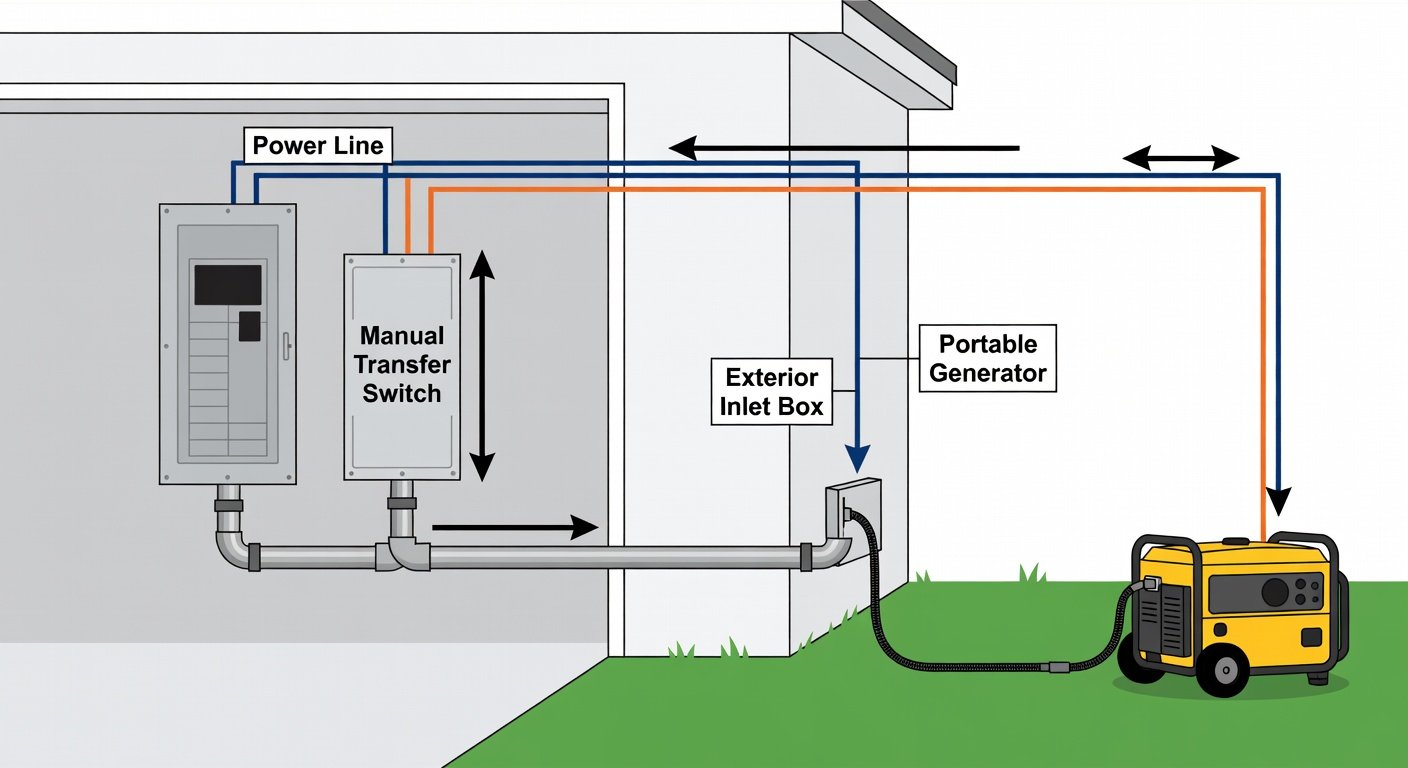
Before you buy anything or call an electrician, understand the full equipment list. The specific components depend on whether you are connecting a portable generator or a permanent standby unit — but the core safety infrastructure is the same. For a portable generator setup, you need a manual transfer switch (or main panel interlock kit), a weatherproof generator inlet box mounted on your exterior wall, a heavy-duty generator power cord (10-gauge for 30A, 8-gauge for 50A), and appropriate circuit breakers. For a standby generator setup, add an automatic transfer switch (ATS), a natural gas or propane supply line, a concrete or composite generator pad, and weatherproof conduit running from the generator pad to the main panel.
The NFPA estimates that roughly 3 million U.S. homes now have a permanently installed standby generator — a figure that has doubled since 2015. Generator Junkie’s hands-on testing across dozens of installations has confirmed that transfer switch panels from Reliance Controls and Generac offer the most flexible circuit-selection options for portable setups, while main panel interlock kits from Square D and Cutler-Hammer keep costs down for homeowners who want whole-panel coverage from a large portable unit.
| Component | Portable Generator Setup | Standby Generator Setup | Approx. Cost |
|---|---|---|---|
| Transfer Switch | Manual (6–10 circuits) | Automatic (whole-home ATS) | $300–$900 / $1,500–$5,000 |
| Inlet Box | Required (exterior wall) | Integral to installation | $50–$150 |
| Power Cord | 30A or 50A twist-lock cord | Not applicable | $40–$200 |
| Generator Pad | Optional (rubber mat) | Required (concrete/composite) | $100–$600 |
| Conduit & Wiring | Included in switch install | Separate permit/install required | Varies by run length |
| Fuel Connection | Gasoline (self-managed) | Licensed plumber for gas line | $200–$800 |
| Electrician Labor | $200–$700 | $500–$2,500 | Regional market rate |
What Is a Transfer Switch — and Do You Really Need One?
A transfer switch is the electrical device that safely disconnects your home from the utility grid and connects it to your generator. Think of it as a traffic signal for power: it ensures electricity flows in only one direction at a time — from the grid OR from your generator, never both simultaneously. This device is not optional equipment. NEC Article 702 (“Optional Standby Systems”) mandates that all generator connections to a home’s wiring system use a transfer switch or an equivalent interlock device. As of 2026, 47 of 50 states have adopted either the 2020 or 2023 NEC cycle, meaning this requirement applies virtually everywhere in the country.
There are two main categories: a transfer switch sub-panel (a dedicated breaker panel wired to your selected essential circuits, mounted beside your main panel) and a main panel interlock kit (a mechanical bracket that physically prevents the main utility breaker and the generator breaker from both being engaged at once). Both are fully code-compliant when professionally installed. Generator Junkie’s recommendation: transfer switch sub-panels work best for portable generator owners who want to manage 6–10 specific circuits; interlock kits suit homeowners with large enough portable generators to run the whole panel and who want a lower-cost solution.
Manual vs. Automatic Transfer Switch: Which Should You Choose?
This is the most common question Generator Junkie receives from first-time generator buyers, and the answer depends on your budget, your generator type, and how hands-on you are willing to be during an outage. A manual transfer switch costs $500–$1,500 fully installed and requires you to physically start the generator, walk to the transfer panel, and flip each circuit switch when the power goes out. It is the standard choice for portable gasoline generators and works reliably for the vast majority of residential situations.
An automatic transfer switch (ATS) continuously monitors incoming utility voltage. Within 20–30 seconds of detecting an outage, it automatically starts the standby generator and transfers the electrical load — no human intervention required, even if you are asleep or away from home. Research from the Generator & ATS Industry Association shows that homes with automatic standby systems achieve 99.8% power availability during grid outage events, compared to approximately 68% for homes relying on portable generators (assuming prompt manual response). For households with medical equipment, home offices, or freezers full of food, that gap is decisive.
| Feature | Manual Transfer Switch | Automatic Transfer Switch (ATS) |
|---|---|---|
| Generator Type | Portable (gasoline) | Standby (natural gas / propane) |
| Outage Response | Manual — you start & switch | Automatic (~20–30 seconds) |
| Circuits Covered | Typically 6–10 selected circuits | Whole home |
| Installed Cost | $500–$1,500 | $3,000–$10,000+ |
| Best For | Budget-conscious homeowners, occasional outages | Medical equipment, home offices, cold climates, frequent outages |
| Ongoing Fuel Cost | Gasoline (variable, store carefully) | Natural gas / propane (consistent billing) |
| NEC 702 Compliant | ✅ Yes | ✅ Yes |
| Power Availability | ~68% (with prompt response) | ~99.8% |
How Do You Connect a Portable Generator to Your House Step by Step?
This is the most widely used generator connection method in the U.S. — and when executed correctly, it is safe, effective, and affordable. The process splits into two phases: the one-time installation (steps 1–4, performed by a licensed electrician) and the outage procedure (steps 5–8, performed by you). Generator Junkie strongly recommends running through steps 5–8 as a practice drill before an actual emergency so the process is second nature when the lights go out.
- Size your generator correctly. List every circuit you want to power — refrigerator (~700W), sump pump (~1,200W), furnace blower (~800W), well pump (~1,000W), lighting (~500W) — and total the running watts. Add 20–25% for motor startup surge. Most households need a 5,500W–10,000W portable unit to cover essential circuits comfortably.
- Choose your transfer device. A dedicated transfer switch sub-panel (Reliance Controls, GenTran, Generac) handles 6–10 pre-selected circuits cleanly. A main panel interlock kit (Square D, Cutler-Hammer, Siemens) is a lower-cost option that lets you power any circuit in the main panel — provided your generator is large enough for the total load.
- Hire a licensed electrician and pull a permit. The electrician mounts the transfer switch or installs the interlock, runs appropriately sized copper wiring through weatherproof conduit, and installs a NEMA 3R-rated generator inlet box on the exterior wall of your home. This work requires a permit in virtually every U.S. jurisdiction — budget $50–$200 for the permit fee.
- Schedule and pass the electrical inspection. Your municipality’s electrical inspector verifies that the installation meets NEC Article 702 and all local amendments. Do not skip this step. Uninspected work can void your homeowner’s insurance and creates significant liability when selling your home.
- Position the generator safely during an outage. Roll your generator to a flat surface at least 20 feet from any door, window, vent, or soffit. Point the exhaust away from the structure. This 20-foot rule is the single most important CO-prevention measure you will take.
- Connect the power cord. Plug your heavy-duty generator cord (30A or 50A twist-lock, never a standard extension cord) into the weatherproof exterior inlet box. The cord only connects here — never directly to a wall outlet.
- Start the generator and allow a 2-minute warm-up. Let the engine reach stable RPM before applying electrical load. This protects sensitive electronics from voltage irregularities during startup.
- Execute the transfer sequence. On the transfer sub-panel: turn the utility main to OFF, then flip each desired circuit to GEN. On an interlock kit: disengage the main utility breaker using the interlock bracket, then engage the generator breaker. Bring circuits online gradually — largest motor loads first — to prevent voltage sag.
How Do You Connect a Whole-Home Standby Generator?
A standby generator — from brands like Generac, Kohler, Briggs & Stratton, or Champion — is a permanently installed unit running on natural gas or propane. Installation is more involved than a portable setup, but the result is seamless, automatic, whole-home protection that requires zero action from you during an outage. According to Generac’s 2025 homeowner survey, 78% of standby generator owners report using their system at least once in the prior 12 months — and 91% said they would recommend the investment to a neighbor.
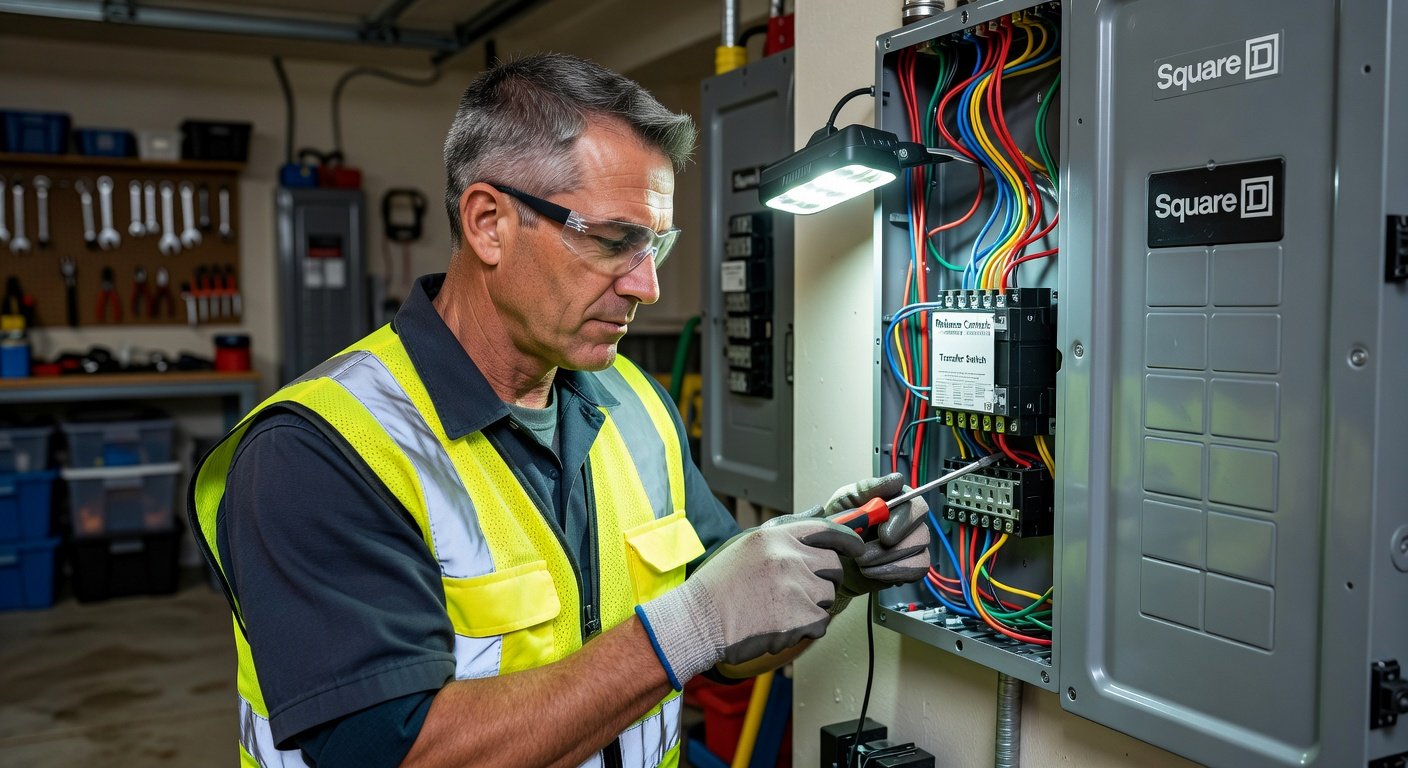
The complete standby installation sequence: (1) select generator size using Generator Junkie’s sizing calculator and confirm with your utility that your gas meter can support the added BTU load; (2) pour a concrete pad or order a pre-formed composite pad sized to the unit; (3) have a licensed plumber or gas fitter connect the natural gas supply line or install a propane tank; (4) have a licensed electrician install the ATS at the main panel, run conduit to the generator pad, and complete all grounding and bonding; (5) schedule the dealer’s commissioning visit to perform first-start checks, load testing, and warranty registration. Budget 1–3 weeks from contract signing to first automatic startup. Data from Angi (2025) shows the national average for a complete standby installation — unit plus labor — is $6,200 to $11,500.
What Electrical Codes Apply When Connecting a Generator in 2026?
Generator connections to residential wiring are governed primarily by NEC Article 702 (Optional Standby Systems). The 2023 NEC cycle — which the majority of states are actively adopting in 2025–2026 — includes updated requirements for transfer switch circuit labeling, inlet box mounting height and weatherproofing, and mandatory CO alarm integration when a generator connection is permitted. Key 2026 requirements every homeowner should know: (1) a transfer switch or listed interlock device is legally mandatory — no exceptions; (2) the exterior inlet box must carry a minimum NEMA 3R weatherproof rating; (3) all generator circuit wiring must be run in weatherproof conduit using copper conductors sized to the circuit’s ampacity per NEC Table 310.16; (4) most jurisdictions now require a CO detector on every habitable floor as a condition of generator installation permit approval.
Additional requirements that catch homeowners off-guard: the generator’s frame must be bonded to the home’s grounding electrode system (a separate grounding rod driven near the generator is often also required); the inlet box must be labeled with the voltage, amperage, and frequency it is rated for; and the transfer switch must carry a label identifying the circuits it controls. Failure to comply can result in fines up to $10,000 per violation in some states, plus a mandatory order to remove and redo all non-compliant work at the homeowner’s expense.
How Do You Prevent Carbon Monoxide Poisoning When Running a Generator?
Carbon monoxide is colorless, odorless, and fast-acting. At concentrations above 150 ppm it causes headache and dizziness within hours; at 1,200 ppm — a level a portable generator can produce within feet of an open window — it causes loss of consciousness and death within minutes. The CPSC reports that over 70% of generator-related CO deaths occur inside the home or in an attached garage, almost always because the generator was placed too close to an opening. The remaining deaths typically occur in basements, enclosed patios, or partially open structures where ventilation is assumed but insufficient.
Generator Junkie’s CO prevention protocol: never run a generator inside any enclosed or partially enclosed structure — no garage (even with the door open), no basement, no shed, no covered patio. Position the generator at least 20 feet from every door, window, vent, soffit opening, and air intake on the home. Point the exhaust away from the building. Install battery-powered, interconnected CO alarms on every floor, especially outside sleeping areas — when one triggers, they all trigger, waking the whole household. Test CO alarms monthly. Replace them every 5–7 years per manufacturer recommendation. If an alarm sounds while the generator is running: evacuate immediately, leave doors open as you exit, call 911, and do not re-enter until emergency services clear the structure.
How Much Does It Cost to Connect a Generator to Your House?
Cost is the most-searched aspect of home generator connection — and the range is genuinely wide. The good news: there is a code-compliant solution at nearly every budget level. Generator Junkie’s 2026 cost breakdown is based on aggregated pricing from Angi, HomeAdvisor, and direct contractor quotes across 12 U.S. regional markets.
| Setup Type | Generator Cost | Installation Cost | Total Range |
|---|---|---|---|
| Portable + Manual Transfer Switch (6–10 circuits) | $700–$2,000 | $400–$900 | $1,100–$2,900 |
| Portable + Whole-Panel Interlock Kit | $1,500–$3,500 | $300–$700 | $1,800–$4,200 |
| Standby (10–20kW) + Automatic Transfer Switch | $3,500–$7,000 | $2,000–$5,000 | $5,500–$12,000 |
| Standby (22kW+) + Full-Home ATS | $5,500–$12,000 | $3,000–$8,000 | $8,500–$20,000 |
According to Angi’s 2025 national data, the average all-in cost for a portable generator connection with manual transfer switch is $1,847. For a complete standby system including the generator unit, the median installed cost is $8,400. Key cost variables include local electrician labor rates (highest in California, New York, and Massachusetts), the distance from your main panel to the exterior inlet box, whether your panel needs an upgrade to accommodate the new circuits, and whether a new gas line must be run from the meter to the generator pad.
What Are the Most Common Generator Connection Mistakes — and How Do You Avoid Them?
After reviewing hundreds of reader-submitted generator setups and fielding questions from installers across the country, Generator Junkie has identified the same errors coming up repeatedly. Avoiding these protects your equipment, your family, and your wallet.
- Undersizing the generator. Homeowners consistently underestimate total load — especially the startup surge of motor-driven appliances. An AC compressor, sump pump, or well pump can draw 2–3× its running wattage at startup. Always add 20–25% to your total running wattage when calculating required generator size.
- Using an undersized extension cord. Standard 14-gauge or 16-gauge household extension cords are not rated for generator loads. Use only 10-gauge (30A) or 8-gauge (50A) cords, and keep runs as short as possible. Undersized, overloaded cords cause voltage drop, overheating, and fire risk.
- Skipping the permit. Unpermitted generator connections are illegal, can void your homeowner’s insurance policy, and become a costly obstacle when selling your home. A permit costs $50–$200 and provides legal protection in every scenario.
- Improper generator grounding. The generator’s frame must be bonded to the home’s grounding electrode system. Skipping this creates shock hazards, can damage sensitive electronics, and fails inspection every time.
- Refueling a hot generator. Gasoline spilled on a hot engine can ignite instantly. Always shut the generator down completely and allow 2 minutes of cooling before adding fuel.
- Neglecting oil change intervals. Most manufacturers require an oil change after the first 20 hours on a new unit, then every 100 hours of operation thereafter. Skipping oil changes is the leading cause of premature generator engine failure — and voids most warranties.
Frequently Asked Questions
Can I connect a generator to my house without a licensed electrician?
For the panel work — no, in nearly every U.S. jurisdiction. Installing the transfer switch, running the conduit wiring, and mounting the inlet box must be done by a licensed electrician who pulls a permit and submits to inspection. Some states allow licensed homeowners to perform their own electrical work, but you still need the permit and inspection. Once the electrical infrastructure is installed and inspected, plugging in the generator during an actual outage is absolutely something any homeowner can do themselves.
How long can a generator power my house?
A portable gasoline generator will run 8–18 hours on a full tank depending on load and tank size. A natural gas standby generator can run indefinitely as long as your gas utility supply remains intact — most homeowners run them continuously for 3–7 days during extended outages without issue. A propane-fueled standby generator depends on tank size: a 500-gallon propane tank provides roughly 5–7 days of whole-home power under typical residential loads.
What size generator do I need to power my whole house?
To run a typical 2,000–2,500 sq ft home with central air conditioning, plan on a minimum of 20–22kW. For essential circuits only — refrigerator, lights, sump pump, furnace blower, and one small window AC — a 5,500W–8,000W portable generator is usually sufficient. Use Generator Junkie’s free online sizing calculator at generatorjunkie.com to get a precise recommendation based on your specific appliance list and square footage.
Will a generator connection increase my home’s resale value?
Yes — especially for standby systems. A 2025 study by the National Association of Realtors (NAR) found that homes with permanently installed standby generators sold for an average of 3–5% more than comparable homes without one in markets with frequent outage history — including the Southeast, Northeast, and Midwest. In storm-prone coastal markets the premium can approach 7–8%. Portable generator setups add minimal direct appraised value but can meaningfully differentiate a listing in outage-prone neighborhoods.
What is the best generator brand for home connection in 2026?
For standby generators, Generac commands approximately 70% of the U.S. residential market and offers the widest dealer and service network in the country. Kohler and Briggs & Stratton are premium alternatives with excellent long-term support. For portable generators, Honda’s EU series consistently leads in reliability and fuel efficiency; Champion and DuroMax deliver the best value per watt at mid-range price points. Generator Junkie publishes comprehensive brand-by-brand reviews and head-to-head comparisons at generatorjunkie.com.
Do I need separate permits for the generator and the electrical work?
Often yes — particularly for standby generator installations. The electrical work (transfer switch, inlet box, wiring) typically requires an electrical permit pulled by your licensed electrician. A gas line extension requires a separate plumbing or gas permit pulled by a licensed plumber or gas fitter. The generator unit itself may require a mechanical permit in some jurisdictions, especially in HOA communities or municipalities with strict setback and noise ordinances. Your electrician and dealer should pull all applicable permits on your behalf as part of their scope of work.
Your Next Steps: A 30-Day Timeline to Get Connected
Connecting a generator to your house is one of the highest-impact home resilience investments available in 2026. Power outages are becoming longer and more frequent — and the difference between a home with a proper generator connection and one without has never been more visible. Here is Generator Junkie’s recommended 30-day timeline to get your home safely connected.
- Days 1–5 — Assess and Size. List every circuit you want to back up. Use Generator Junkie’s sizing calculator. Decide between a portable + manual transfer switch setup versus a standby + ATS based on your budget, outage frequency, and whether anyone in the household has medical equipment that cannot tolerate any power interruption.
- Days 5–12 — Gather Quotes. Contact 2–3 licensed electricians. Ask each one specifically about transfer switch installation cost, permit fee, and whether your panel needs upgrading. For standby systems, contact authorized Generac, Kohler, or Champion dealers for complete turnkey quotes that include the unit, pad, gas line, ATS, and commissioning.
- Days 12–18 — Purchase Equipment. Order your generator and transfer switch. Confirm your electrician has sourced all components and submitted the permit application. Most permit approvals take 3–7 business days.
- Days 18–26 — Installation and Inspection. Electrician installs the transfer switch and inlet box. Permit inspection is scheduled and completed. For standby systems, the plumber completes the gas line, the electrician completes the electrical work, and the dealer performs generator commissioning.
- Days 26–30 — Test, Train, and Document. Run a full load test across all backed-up circuits. Confirm everything transfers correctly. Walk every household member through the start-up checklist. Register the generator with the manufacturer. Store your permit and inspection paperwork with your home documents.
Generator Junkie’s Recommended Resources for 2026
- Generator Junkie Sizing Calculator — generatorjunkie.com/calculator — free, appliance-by-appliance wattage tool
- CPSC Generator Safety Checklist — cpsc.gov — official federal CO prevention guidance
- NEC Article 702 Text — nfpa.org — the complete legal standard for optional standby systems
- ESFI Generator Safety Resources — esfi.org — plain-language safety guides for homeowners
- Reliance Controls Transfer Switch Selector — reliancecontrols.com — match transfer switch to your panel and load
- Angi Licensed Electrician Finder — angi.com — find and compare vetted local electricians with verified reviews
- Generac Home Standby Dealer Locator — generac.com/dealer-locator — find factory-authorized installers near you
Looking ahead to 2026–2027, the most significant trend in home generator connection is smart integration. Generac’s PWRcell platform, hybrid generator-battery systems from EcoFlow and Bluetti, and emerging whole-home energy management solutions allow generators to intelligently charge home battery banks during off-peak operation — reducing fuel consumption by up to 40% while maintaining full backup coverage. Expect WiFi-connected ATS units with remote monitoring, automatic weekly self-testing, and AI-driven load-shedding to become standard offerings at mid-range price points by late 2027. Generator Junkie will cover every development in real time at generatorjunkie.com.
Whether you are starting with a portable generator and a basic manual transfer switch or investing in a full whole-home standby system, the most important step is identical: connect it correctly, get it inspected, and get your household covered before the next outage arrives. Your family’s safety depends on the quality of that connection — and now you have everything you need to get it right.
—