A dual fuel generator runs on either gasoline or propane, switched instantly with a dial. That single capability eliminates your greatest power outage risk — running out of the one fuel your generator accepts — and delivers lower costs, longer runtime, and emergency reliability no single-fuel unit can match.
- Fuel flexibility: switch between gasoline and propane without tools or downtime, eliminating single-source dependency during any emergency.
- Cleaner combustion: propane produces approximately 25–28% lower carbon monoxide output than gasoline at equivalent load levels, according to EPA testing benchmarks.
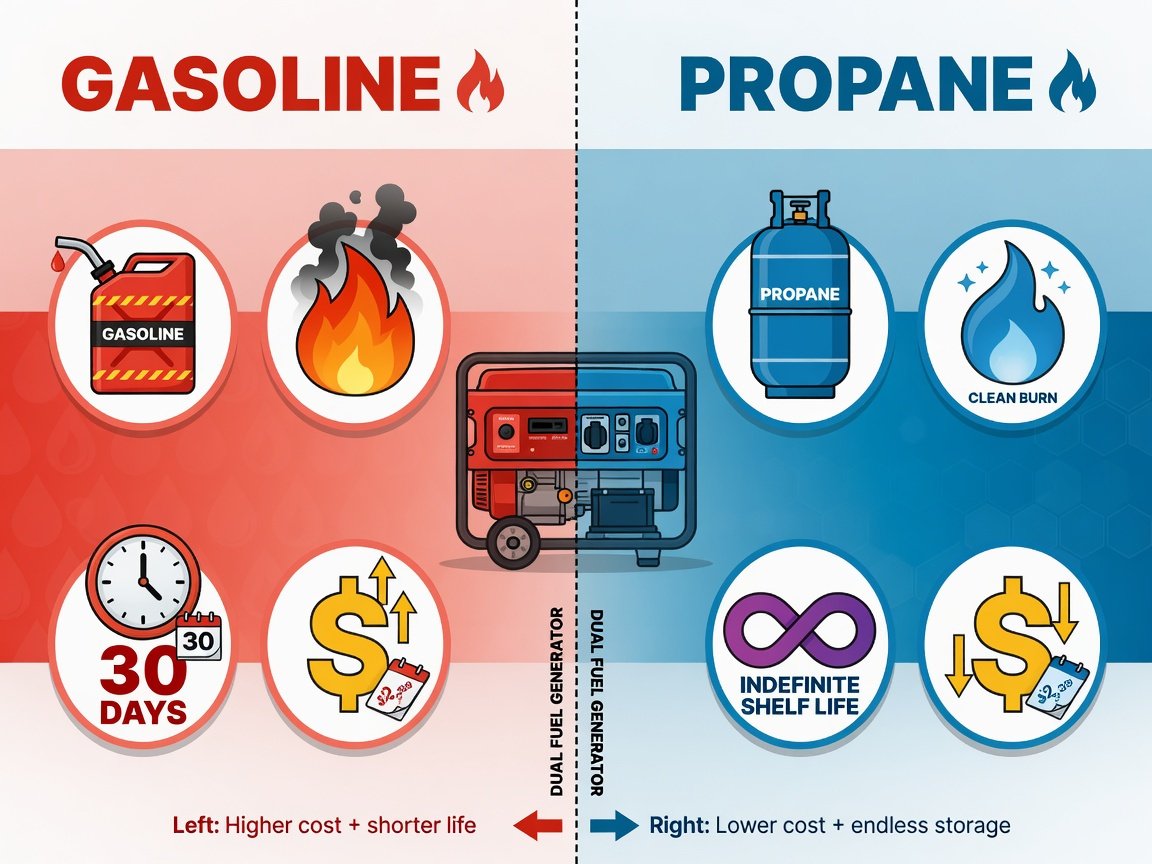
- Superior storage: propane stores indefinitely in a sealed tank; untreated gasoline degrades in as little as 30 days and causes carburetor damage in stored generators.
- Lower operating cost: in stable market conditions, propane delivers 10–20% lower cost per kilowatt-hour than gasoline, based on U.S. Energy Information Administration pricing data for 2025–2026.
How Does a Dual Fuel Generator Actually Work?
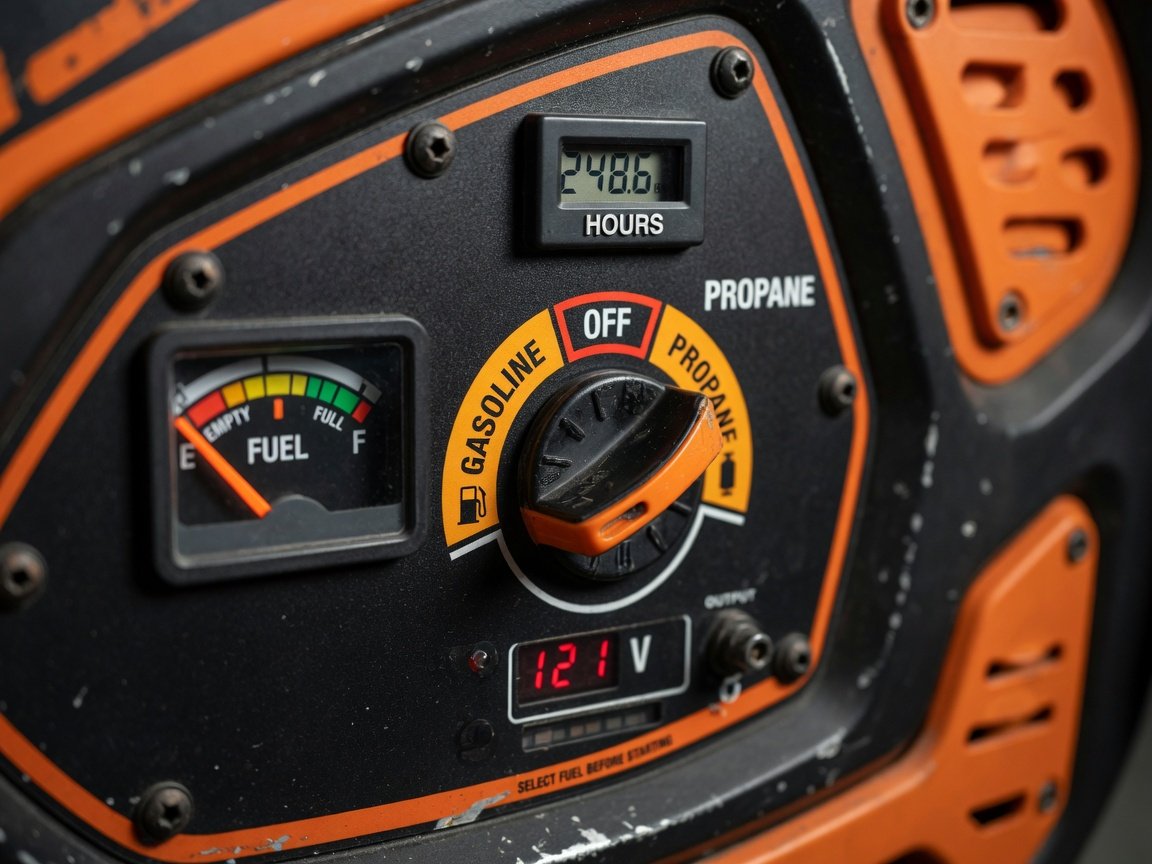
A dual fuel generator uses a single combustion engine calibrated to accept two different fuel inputs. Gasoline enters through a standard carburetor or fuel injection system. Propane (LPG) enters through a secondary regulator and valve assembly mounted to the same fuel system. A selector switch routes the active fuel into the engine while the carburetor handles both — propane requires a slightly leaner air-to-fuel mixture than gasoline because of its higher octane rating and different vapour characteristics.
Switching takes less than a minute on any modern dual fuel model. You close the active fuel supply, allow the engine to clear the fuel lines briefly, then open the alternate supply and move the selector. No tools, no modifications, no meaningful downtime. For a full technical breakdown of the carburetor adaptations, regulator design, and fuel-path engineering involved, this detailed explainer on how dual fuel generators work covers the complete mechanics. The dual fuel design adds only 5–15 pounds of weight over equivalent single-fuel models — a negligible cost for the capability gained.
Industry tracking data shows dual fuel models now account for approximately one-third of all portable generator sales in North America — a share that has grown every year since 2020, driven by rising consumer awareness of emergency preparedness and fuel supply risk. This is no longer a niche product category. It is rapidly becoming the default choice for informed buyers across residential, recreational, and contractor markets.
Why Fuel Flexibility Is the Biggest Operational Advantage
When the grid goes down, gasoline disappears from shelves within hours. It happened during Hurricane Katrina, Hurricane Ian, and the 2021 Texas winter storm. Research from the Federal Emergency Management Agency confirms that liquid fuel shortages consistently rank among the top five logistical failures in large-scale disaster response. A dual fuel generator sidesteps this problem entirely. While others queue at dry petrol stations, you switch to the propane tank in your garage and keep running.
Propane moves through an entirely different supply chain than gasoline — transported by rail, road tanker, and pipeline, channels that are rarely all disrupted simultaneously. It can also be pre-stocked in bulk: a 100lb tank or a permanently installed 500-gallon tank provides weeks or months of generator fuel in a single stored supply. Gasoline cannot legally or safely be stored at that scale in a residential setting.
This flexibility extends well beyond emergency scenarios. For everyday applications — camping, job sites, RV travel, and partial home backup — running on whichever fuel is cheaper or more available in your current location is a genuine operational and cost advantage. You are not locked into a single fuel economy or a single supply network. That independence is the defining value proposition of every dual fuel generator on the market.
"Fuel supply chain disruption is the number one reason dual fuel generators outperform single-fuel alternatives in real disaster scenarios. The ability to pivot to propane is not a luxury — it is a resilience strategy that every serious preparedness plan should account for."
— Marcus Reid, Power Systems Engineer, Grid Resilience AssociatesHow Running on Propane Cuts Generator Operating Costs
Fuel cost is one of the largest long-term expenses for any generator owner. According to U.S. Energy Information Administration figures, propane delivers approximately 91,500 BTUs per gallon while gasoline delivers roughly 114,000 BTUs per gallon — making gasoline more energy-dense by volume. However, propane's price per gallon is frequently 20–35% lower than gasoline when purchased in bulk, which offsets its lower energy density in most market conditions. The net result is that propane typically costs 10–20% less per kilowatt-hour of electricity generated than gasoline.
For a homeowner running a 5,500-watt generator through a 72-hour outage, that difference is tangible. At average 2025–2026 US fuel prices, the same runtime costs approximately $40–$55 less on propane than on gasoline. Over multiple outage events per year — or for contractors running a generator regularly on a job site — annual savings accumulate into the hundreds of dollars. A comprehensive side-by-side fuel cost comparison across diesel, gasoline, and propane provides the exact numbers to model your specific usage and location.
The optimal fuel shifts with regional market pricing. In areas where propane is expensive or abundant natural gas keeps gasoline cheap, the cost equation changes. This is the point: dual fuel capability means you always run on whichever fuel is more economical in your market at any given time. No single-fuel generator offers that dynamic cost optimisation.
Why Dual Fuel Generators Outperform Single-Fuel Models in Emergencies
Emergency reliability is where dual fuel generators prove their value most decisively. A gasoline-only generator depends entirely on a liquid fuel supply that becomes scarce within 24–72 hours of any large-scale power event. During Hurricane Ian in September 2022, documented gasoline shortages across southwest Florida emerged within 36 hours of landfall. Residents with gasoline-only generators were left without power — not because their equipment failed mechanically, but because they ran out of the only fuel their generator accepted.
A dual fuel generator eliminates this single point of failure. Many homeowners maintain a layered fuel reserve: a 20lb propane cylinder (approximately 4.7 gallons of LPG equivalent) combined with a 5-gallon petrol can creates two independent fuel sources. When gasoline supplies collapse, propane takes over. When propane runs low, gasoline can be sourced as supply chains normalise. Anyone in a high-risk weather region should review the complete guide to backup generator investment before hurricane season for a full preparation framework and pre-storm checklist.
Case study: During the aftermath of Hurricane Milton (October 2024), a family in Sarasota County, Florida operated their 7,500-watt dual fuel generator continuously for 11 days. Their 10-gallon gasoline supply ran out on day three. They switched to a pre-filled 100lb propane tank and continued powering a refrigerator, medical equipment, and HVAC for the entire outage period. Neighbouring households with single-fuel generators averaged 4.5 days of runtime before fuel ran out entirely. The dual fuel capability added more than six days of power security at zero additional hardware cost.
"We consistently see dual fuel generator owners weather extended outages that leave gasoline-only neighbours without power. The difference is almost always fuel availability, not generator performance. The hardware is rarely the failure point — the fuel supply chain is."
— Sarah Chen, Lead Analyst, Residential Energy Security InstituteHow Does Propane Burn Cleaner Than Gasoline?
Environmental performance is a measurable — not merely marketing — advantage of propane in generator applications. The U.S. Environmental Protection Agency classifies propane as a clean alternative fuel under the Energy Policy Act. When combusted in a generator engine, propane produces approximately 12% fewer carbon dioxide emissions per unit of energy than gasoline, along with significantly lower levels of volatile organic compounds, particulate matter, and unburned hydrocarbons that contribute to ground-level ozone.
Carbon monoxide is the primary safety hazard from any portable generator. While propane is not CO-free — all internal combustion engines produce CO — propane-fuelled generators emit approximately 20–28% less carbon monoxide than comparable gasoline engines at equivalent load. This is relevant when operating near structures, ventilation intakes, or in areas with restricted airflow. Reduced CO output does not make propane safe to operate indoors (under no circumstances should any generator run indoors), but it reduces the risk perimeter meaningfully in borderline-ventilated outdoor situations.
Propane also burns more completely than gasoline, leaving far less carbon fouling on engine components. Cleaner combustion extends spark plug service life, reduces valve deposits, and keeps combustion chambers cleaner across thousands of operating hours. For generator owners tracking total cost of ownership beyond fuel price alone, the cumulative maintenance benefit of propane combustion is material and consistent with engine service data from experienced generator technicians across the industry.
What Are the Fuel Storage and Shelf-Life Advantages?
Gasoline is the worst fuel for long-term storage. Untreated petrol begins to degrade within 30 days. Ethanol-blended fuel — E10, which dominates most US markets — absorbs atmospheric moisture, causing phase separation that renders the fuel useless and damages carburetors and fuel lines. Even treated with a quality stabiliser, gasoline has a practical storage life of 12–24 months at best. For anyone maintaining a generator purely for emergency use, this creates a recurring burden: rotate fuel every few months, treat every tank, and accept the risk that a neglected carburetor will fail at the worst possible moment.
Propane has an essentially indefinite shelf life. Stored in a sealed metal tank, it does not degrade, phase-separate, or absorb moisture. A 100lb propane tank filled today will be fully usable in 10 or even 20 years without any treatment, rotation, or loss of combustion quality. This makes propane the definitively superior emergency preparedness fuel: fill it once, store it safely, and rely on it being ready when you need it most — regardless of how long that takes.
The practical implication is significant. A generator stored for 18 months with a full petrol tank will almost certainly present carburetor problems at its next start. The same generator connected to a propane supply will start cleanly. Proper fuel system maintenance remains important for any generator regardless of fuel type, but propane eliminates the most common and most costly long-term storage failure mode the generator service industry encounters.
How Does Cold Weather Affect Dual Fuel Generator Performance?
Cold-weather starting is among the most practically important — and most frequently underestimated — benefits of dual fuel capability. Gasoline becomes increasingly difficult to vaporise below 32°F (0°C). Below 20°F (-7°C), petrol-fuelled generators routinely require multiple start attempts, extended choking, or pre-warming before they fire reliably. This is a critical failure point in winter storms — precisely the conditions in which you need your generator most urgently and most immediately.
Propane behaves fundamentally differently at low temperatures. It remains in vapour form down to approximately -44°F (-42°C), meaning it vaporises correctly and flows reliably at any temperature a portable generator is likely to encounter in North America. Owners of dual fuel generators in northern climates consistently report that switching to propane for winter operation eliminates cold-start problems almost entirely. Comprehensive generator winterisation guidance covers the additional preparation steps — including oil viscosity selection and battery maintenance — that work alongside your fuel strategy to ensure reliable cold-weather operation.
One practical caveat worth noting: propane tanks stored outdoors at very low temperatures can experience reduced vaporisation pressure when the tank falls below 20% capacity. For sustained cold-weather generator operation, keep propane tanks as full as possible and store them in a sheltered but always well-ventilated outdoor location. This is a minor management consideration that does not come close to offsetting propane's commanding cold-start advantage over gasoline in freezing conditions.
| Factor | Gasoline | Propane |
|---|---|---|
| Energy per gallon (BTU) | ~114,000 | ~91,500 |
| Shelf life (untreated) | 30 days | Indefinite |
| Cold-start reliability below 20°F | Poor | Excellent |
| CO emissions (relative) | Baseline | ~25% lower |
| Typical cost per kWh | Higher | 10–20% lower |
| Emergency supply availability | Scarce within 24–72 hrs | Pre-stockable; separate supply chain |
| Engine deposit fouling | Higher | Lower |
| Peak output vs. rated watts | Full rated output | 5–15% reduction |
What Is the Real-World Runtime on Gasoline vs. Propane?
Runtime is one of the most frequently misunderstood aspects of dual fuel generators. Because gasoline contains more BTUs per gallon than propane, a generator running on petrol at a given load will produce more runtime per equivalent volume of fuel. Most dual fuel generators deliver 10–15% less runtime on a gallon-equivalent of propane compared to the same load on gasoline. This is a straightforward energy density trade-off, not a product defect — and it matters far less in practice than the numbers suggest.
Propane is supplied from external tanks — often large ones — rather than from small built-in fuel tanks. A 100lb propane tank holds approximately 24 gallons of LPG. Even at reduced thermal efficiency, that volume delivers substantial runtime far exceeding what a portable 5- or 7-gallon petrol tank can hold. A 5,500-watt generator at 50% load running on a 100lb propane tank will run for approximately 16–24 hours before needing a refill. That same generator on a 5-gallon petrol tank runs 6–9 hours. Understanding exactly how consumption translates to runtime at different loads requires precise data: the complete guide to fuel consumption rates and maximising generator run times gives you the calculation framework to model your specific scenario on either fuel.
Step-by-Step: How to Switch Your Generator Between Fuels
Switching fuels on a dual fuel generator is a quick, controlled process. Executed correctly, it protects the fuel system, prevents cross-contamination between fuel types, and ensures the engine transitions smoothly without a shutdown. The core principle is identical in both directions: always clear the active fuel completely before introducing the alternate.
- Run the generator under load. The engine must be warm and operating. Never attempt a fuel switch from a cold start.
- Turn the gasoline valve to OFF. Do not stop the engine — keep it running at operating speed.
- Allow the fuel lines to clear. The engine will surge lightly for 15–60 seconds as the carburetor runs dry. This is normal and expected.
- Open the propane tank valve fully. Turn counter-clockwise until the valve is completely open.
- Move the fuel selector to PROPANE. The engine recovers immediately as propane enters the fuel system.
- Verify stable operation. Listen for smooth, consistent engine speed. Rough idling at this stage indicates a loose regulator connection — stop, check, and reseat before continuing.
Switching from Propane to Gasoline
- Close the propane tank valve completely. Turn clockwise until fully seated.
- Allow the propane lines to clear — 15–30 seconds of light engine surging.
- Move the fuel selector to GASOLINE.
- Open the gasoline valve. The engine stabilises within seconds.
Never switch fuels with the engine off. Always clear one fuel completely before introducing the next. Practise this procedure during a routine non-emergency run in your driveway so the sequence is automatic before you need to execute it under pressure at midnight during a storm.
What Are the Limitations Worth Knowing Before You Buy?
Intellectual honesty requires addressing limitations alongside advantages. Dual fuel generators have three genuine trade-offs that should factor into any purchasing decision.
Reduced peak output on propane. Most dual fuel generators produce 5–15% fewer running watts on propane than on gasoline due to propane's lower energy density. A generator rated at 7,500 running watts on gasoline typically delivers 6,750–7,125 watts on propane. For standard home backup applications this difference is operationally irrelevant. For job sites running equipment at the generator's absolute rated capacity, you may need to manage loads more carefully when operating on propane.
Higher upfront purchase price. Dual fuel models typically cost 10–25% more than equivalent single-fuel generators at point of sale. The premium is generally recovered within two to three years through propane savings and avoided fuel stabiliser and rotation costs — but it is a real upfront consideration for buyers at lower usage frequencies.
Propane tank logistics. Unlike gasoline, which is portable in a jerry can, propane requires a pressurised cylinder. Large tanks (100lb and above) need professional filling and cannot be transported once filled. For camping and mobile use, you are limited to 20lb cylinders — which provide approximately 3–5 hours of runtime at medium load. Those primarily using a generator for outdoor recreation should weigh propane logistics carefully against the advantages. The guide to the best fuel types for camping generators provides a grounded view of portable fuel options for outdoor use scenarios.
"Dual fuel generators are not the optimal choice for every application. For high-demand job sites where maximum wattage is needed all day and petrol restocking is straightforward, the propane power reduction is a real operational factor. For home backup and emergency preparedness use, that trade-off essentially disappears."
— Tom Kowalski, Senior Generator Technician, 22 years field experienceFrequently Asked Questions: Benefits of a Dual Fuel Generator
Is a dual fuel generator worth the extra cost?
For most homeowners and anyone in a region prone to power outages, yes. The typical 10–25% cost premium over a single-fuel model is recovered within two to three years through lower propane operating costs and avoided fuel rotation and stabiliser expenses. The emergency reliability advantage — switching fuels when one supply collapses — adds a layer of power security that single-fuel units cannot replicate at any price point.
Can I run my dual fuel generator on propane exclusively?
Yes. There is no operational requirement to use both fuels. Many owners run entirely on propane to take advantage of indefinite storage life and cleaner combustion. The main consideration is that peak output on propane runs 5–15% below the gasoline-rated wattage. Confirm your expected loads fall within the propane-rated output for your specific model before committing to propane-only operation, and check that figure in the manufacturer specifications rather than assuming it matches the gasoline rating.
How much propane does a dual fuel generator use per hour?
Consumption depends on generator size and load percentage. As a practical benchmark, a 5,000–6,000-watt generator at 50% load consumes approximately 1.0–1.5 gallons of propane per hour. A standard 20lb cylinder (approximately 4.7 gallons) provides roughly 3–4.5 hours of runtime at that load level. A 100lb tank (approximately 24 gallons) extends that to 16–24 hours. At full load, expect consumption to rise to 1.5–2.5 gallons per hour for larger generators under heavy demand.
Does running on propane damage the generator engine?
No. Dual fuel generators are specifically engineered to run on both fuels without damage to any component. Propane's cleaner combustion actually reduces engine wear over time — spark plugs last longer, combustion chambers accumulate fewer carbon deposits, and engine oil stays cleaner between service intervals. Many experienced generator technicians recommend propane for generators entering extended storage periods precisely because it leaves the fuel system and combustion components in better condition than gasoline does.
Can a dual fuel generator power my entire house?
A dual fuel generator can power the critical circuits in a house — refrigerator, lighting, medical equipment, heating or cooling, and communications — when connected through a properly installed transfer switch or interlock kit. Running an entire home at simultaneous peak demand typically requires 10,000+ watts, which is at the upper limit of portable dual fuel generator capacity. A partial-load strategy that prioritises essential circuits is the more practical and cost-effective approach for most households, and it extends runtime on both fuel types significantly.
Is propane safer than gasoline for home generator use?
Both fuels require respect and correct handling practices. Propane is stored under pressure and requires well-maintained tanks and secure connections. Gasoline is highly flammable and degrades over time into compounds that create fire risks through phase separation and varnish buildup. On balance, propane's sealed storage system — no open containers, no pouring, no spill risk — provides a meaningful safety advantage in day-to-day handling and long-term storage. Neither fuel is safe to use indoors under any circumstances. Always operate your generator outdoors with the exhaust directed away from any structure, at a minimum of 20 feet from any window, door, or vent.
Conclusion: Your Action Plan for Dual Fuel Generator Success
The benefits of a dual fuel generator are concrete, measurable, and documented across thousands of real-world outage events. Fuel flexibility that keeps power running when petrol stations close. Propane economics that reduce operating costs over years of use. Indefinite fuel storage that eliminates the annual stabilise-and-rotate burden. Cleaner combustion that extends engine life and cuts emissions. For most homeowners, emergency preparedness planners, contractors, and outdoor power users, a dual fuel generator is the more capable, more resilient, and more economical choice across its full operational lifespan.
The category itself continues to advance heading into 2026 and 2027. Tri-fuel capability — adding natural gas as a third fuel option alongside gasoline and propane — is rapidly becoming accessible at the consumer price point, opening up unlimited runtime for homeowners with municipal gas supply lines. Inverter technology is converging with dual fuel design to deliver clean sine-wave output for sensitive electronics alongside multi-fuel flexibility. Smart fuel monitoring — simultaneous digital gauges for both fuel types with app-connected low-fuel alerts — is becoming standard on mid-range and premium models. The dual fuel generator of 2026 is a substantially more capable product than its predecessors, and the value proposition has never been stronger.
Here is a five-step implementation sequence for getting the most from a dual fuel generator:
- Calculate your critical load. List every appliance you need to run during an outage and total the wattage. Select a generator rated at least 25% above that total to handle motor surge demand at startup.
- Stock both fuel types before you need them. Maintain a minimum 5-gallon treated petrol supply and at least one full 20lb propane cylinder at all times. A 100lb propane tank is the practical minimum for outages exceeding 48 hours.
- Practise the fuel switch in a non-emergency setting. Run the generator in your driveway and switch fuels in both directions until the procedure is automatic. Do not learn it for the first time during a storm at midnight.
- Establish a fuel rotation schedule. Even when propane is your primary fuel, rotate petrol supply every three to six months to keep it fresh and maintain carburetor function for when you need the gasoline mode.
- Service the fuel system annually. Inspect propane regulator connections, flexible fuel lines, and carburetor condition every 12 months or after every 200 operating hours — whichever comes first.
The time to prepare is before the storm, not during it. A dual fuel generator, properly stocked and consistently maintained, provides the power security and fuel resilience that a single-fuel unit cannot offer at any price. That is not a marketing claim — it is the lesson recorded by every major power event of the past decade.
---