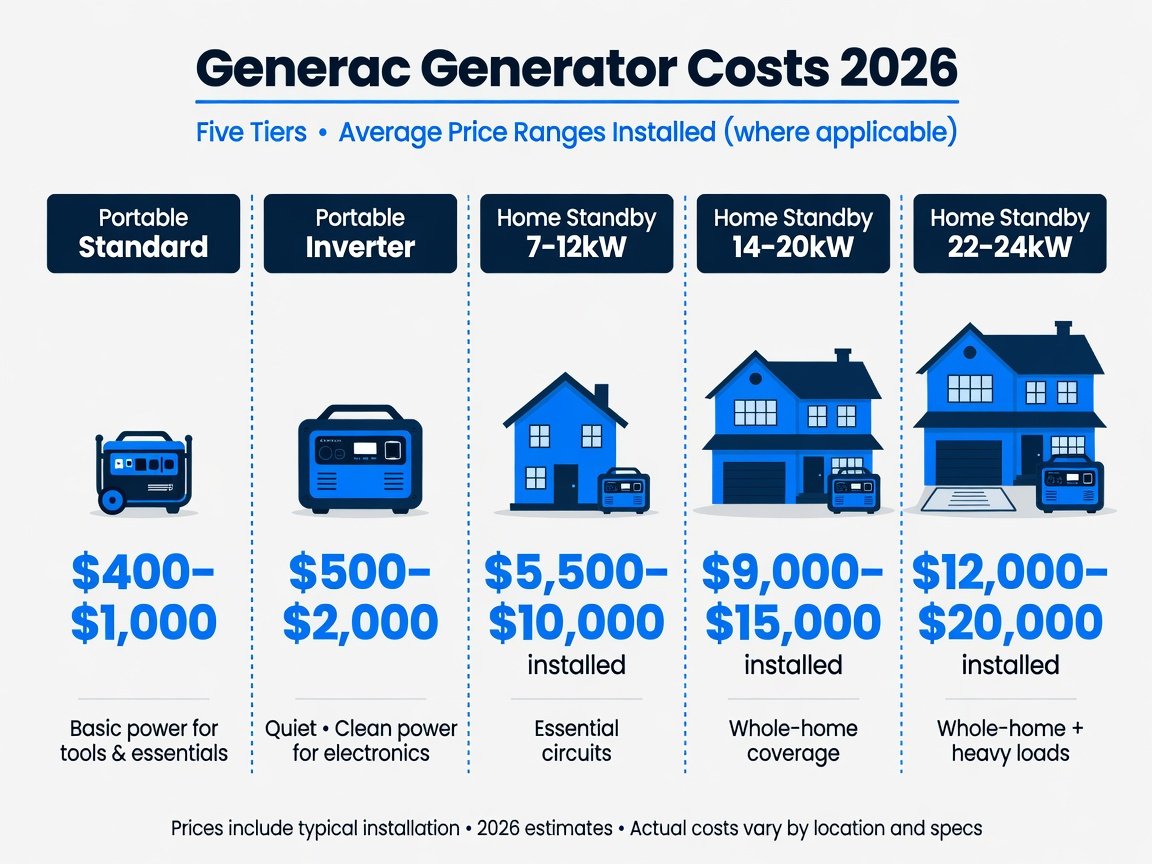
A Generac generator costs between $400 and $20,000+ in 2026, depending on type, wattage, and installation complexity. Portable units start around $400–$800 with no installation required. A fully installed whole-home standby system — including transfer switch, gas connections, and licensed labor — typically lands between $8,000 and $20,000 for most American households.
Generac Generator Cost at a Glance: 2026 Summary
- Portable Generac generators: $400–$2,000, no installation required — suitable for occasional outages, camping, and job sites
- Home standby units (equipment only): $1,900–$6,500 for the 7kW–24kW Guardian series
- Fully installed home standby systems: $7,500–$20,000 all-in, including automatic transfer switch, gas line work, concrete pad, and electrician labor
- Industry research shows Generac holds approximately 75% of the U.S. residential standby generator market — a dominance that sustains a robust dealer network and competitive parts pricing that rivals cannot match
What Does a Generac Generator Actually Cost in 2026?
Generac generator pricing in 2026 spans a wider range than most buyers anticipate. The company manufactures everything from compact recreational portables to high-capacity commercial standby units — and each category carries its own pricing logic, installation requirements, and long-term cost profile. Knowing where you fall on that spectrum is the first step toward building an accurate budget.
According to generator industry data, the average American homeowner investing in a residential standby system spends approximately $11,500–$14,000 all-in for a 14–18kW Generac unit with professional installation. That figure has increased roughly 8–12% since 2023, driven by higher material costs, elevated electrical contractor labor rates, and supply-chain tightening in the residential construction market.
| Generator Type | Unit Price Range | Typical Installed Cost | Ideal Use Case |
|---|---|---|---|
| Portable (standard) | $400–$1,000 | No install needed | Occasional outages, job sites, camping |
| Portable Inverter | $500–$2,000 | No install needed | Sensitive electronics, RVs, quiet operation |
| Home Standby (7–12 kW) | $1,900–$3,200 | $5,500–$10,000 | Essential circuits, smaller homes |
| Home Standby (14–20 kW) | $3,200–$5,000 | $9,000–$15,000 | Full single-family home coverage |
| Home Standby (22–24 kW) | $5,000–$6,500 | $12,000–$20,000 | Large homes, whole-property power |
How Much Does a Generac Portable Generator Cost?
Generac’s portable generator lineup is the most accessible entry point into the brand. These units require no permanent installation, run primarily on gasoline, and can power anything from a sump pump to a home office to a construction site during a short-term outage. According to retail sales data from 2025, portable generators account for approximately 58% of all Generac unit sales by volume — making them far and away the most purchased product in the Generac catalog.
| Model | Output | Approx. Price (2026) | Key Feature |
|---|---|---|---|
| Generac GP2200i | 2,200W | $500–$650 | Compact inverter, parallel-capable, USB ports |
| Generac iQ3500 | 3,500W | $800–$1,000 | Quietest portable in its class, large fuel tank |
| Generac GP5500 | 5,500W | $700–$900 | Open-frame workhorse, GFCI-protected outlets |
| Generac GP8000E | 8,000W | $900–$1,200 | Electric start, power surge protection |
| Generac XC8000E | 8,000W | $1,100–$1,400 | Cold-weather engine, CO-SENSE carbon monoxide protection |
For buyers at the entry level, the Generac 2,500-watt portable inverter represents a compelling starting point — lightweight, quiet, and capable enough for most short-term power needs at $450–$650. Dual-fuel portable models, which run on both gasoline and propane, typically carry a 10–20% price premium over single-fuel equivalents. Industry installer data from 2025 shows dual-fuel units now account for over 35% of portable generator sales nationwide, as homeowners seek fuel flexibility during extended regional shortages when gas stations run dry.
How Much Does a Generac Home Standby Generator Cost?
Home standby generators are Generac’s flagship product — and the category responsible for the brand’s commanding market share. Unlike portables, standby units are permanently installed beside your home, connect to your natural gas or propane supply, and activate automatically within seconds of a grid outage. You never have to pull a cord, haul a machine from storage, or refill a tank during a storm.
The Guardian series covers the vast majority of residential applications, ranging from 7kW (suitable for essential circuits) up to 24kW (capable of powering an entire large home simultaneously). For homeowners who want solid protection without the expense of full whole-home coverage, a partial home generator strategy using a 7–10kW unit paired with a smart transfer switch can cut upfront costs by 30–40% while still protecting the circuits that matter most.
| Model | Output | Unit Price (2026) | Typical All-In Installed Cost | Home Size Guideline |
|---|---|---|---|---|
| Guardian 7kW | 7 kW | $1,900–$2,400 | $5,500–$9,000 | Essential circuits only |
| Guardian 10kW | 10 kW | $2,500–$3,100 | $7,000–$11,000 | Up to ~1,500 sq ft |
| Guardian 14kW | 14 kW | $3,200–$4,000 | $9,000–$13,500 | Up to ~2,000 sq ft |
| Guardian 18kW | 18 kW | $4,000–$4,800 | $10,500–$15,000 | Up to ~2,500 sq ft |
| Guardian 22kW | 22 kW | $4,800–$5,800 | $12,000–$18,000 | Large homes, 3,000+ sq ft |
| Guardian 24kW | 24 kW | $5,500–$6,500 | $13,500–$20,000 | Whole-home, premium applications |
Prices in the unit column reflect typical 2026 retail pricing for the generator alone. Installed figures add a 200-amp automatic transfer switch, licensed electrician labor (8–12 hours), gas line extension, concrete equipment pad, and permit fees. Regional labor markets shift these numbers significantly — contractors in high-demand states like Florida, Texas, and California routinely charge 20–30% above the national average, particularly in the months following major storm events.
What Does Generac Generator Installation Cost?
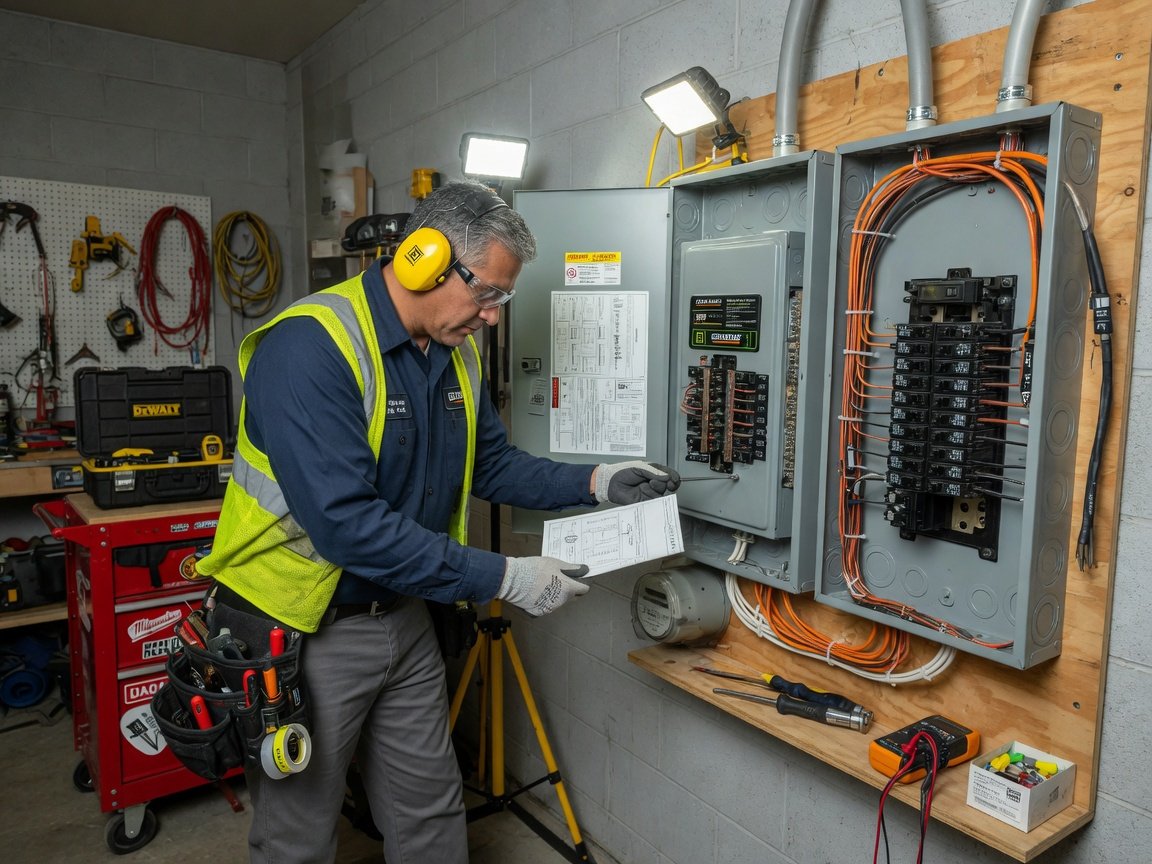
Installation is the most variable — and most consistently underestimated — element of the total Generac generator cost. Homeowners frequently compare unit prices and overlook the reality that licensed labor, permits, a transfer switch, and gas infrastructure can add $3,000–$8,000 to the final bill. Understanding how a Generac generator works mechanically and electrically makes each step in the installation process make sense, and clarifies why each one carries a cost.
⚡ Generac Home Standby Installation: Step-by-Step Cost Breakdown
- Site assessment & permits — $150–$500: A licensed electrician evaluates your panel, gas supply, and placement options. Permit fees vary widely by municipality but are non-negotiable in virtually every jurisdiction.
- Concrete pad or gravel base — $200–$600: The generator must rest on a level, stable surface that meets local code. Pre-poured pads work for standard installs; custom concrete pours are common for irregularly shaped sites.
- Automatic transfer switch (ATS) — $700–$1,600: The ATS disconnects utility power and routes generator power automatically the moment an outage is detected. Part cost runs $400–$900; installation labor adds $300–$700.
- Gas line extension — $300–$1,200: A licensed plumber extends your existing natural gas supply to the generator pad. Propane tank installations add more: budget $500–$2,000 for a new tank lease or purchase.
- Electrical connection & panel work — $500–$1,500: Wiring from the generator to the transfer switch and into your home’s electrical panel. Older panels sometimes require an upgrade before a transfer switch can be safely installed.
- Final inspection & commissioning — $150–$400: A licensed inspector signs off; your Generac authorized dealer activates the warranty registration, programs the weekly self-test cycle, and validates all safety systems.
Total installation labor and materials typically run $3,000–$6,500 for a straightforward project. Complex installs — long gas runs, panel upgrades, difficult siting, or urban permit requirements — regularly push toward $8,000 or more. Always collect three written quotes before committing to an installer, and verify each contractor holds a current state electrical license.
What Hidden Costs Should You Budget For?
The equipment price and installation quote do not capture the full financial picture. Generac generator ownership carries several recurring costs that buyers frequently overlook during the initial purchase decision — costs that compound meaningfully across a 10–15 year ownership period and should be modeled before you sign anything.
- Annual service contract: $200–$400/year for a factory-authorized dealer maintenance plan covering oil changes, spark plug replacement, air filter inspection, and battery testing
- Fuel (natural gas or propane): Approximately $30–$60 per 24-hour operating day for a 14–18kW system on natural gas at 2026 rates; propane costs run $60–$120 per day. Our in-depth portable generator fuel cost comparison breaks down per-hour and per-day costs across all major fuel types
- Extended warranty upgrade: Generac’s standard residential warranty is 5 years on Guardian standby units; an extended 7–10 year plan adds $300–$800 at point of sale
- Starter battery replacement: $80–$180 every 3–5 years — the battery that initiates the automatic start sequence degrades over time regardless of run hours
- Load bank testing: $150–$300 every 2–3 years for high-capacity systems — recommended to verify the generator performs under full load conditions before an actual outage tests it
- Utility standby rate: Some utilities apply a small monthly fee (typically $3–$8/month) to accounts with grid-parallel transfer switch installations
How Does Generac Price Compare to Competitors in 2026?
Generac’s market dominance doesn’t make it automatically the cheapest option — but it consistently delivers the best combination of value, dealer network coverage, and parts availability in the residential standby category. In 2026, the primary competitors are Kohler, Briggs & Stratton, and Champion. Kohler holds approximately 12% of the residential standby market by industry estimates; Champion and Briggs & Stratton split most of the remainder.
| Brand | 10kW Unit Price | 20kW Unit Price | U.S. Dealer Network | Residential Warranty |
|---|---|---|---|---|
| Generac | $2,500–$3,100 | $4,500–$5,500 | 6,000+ dealers | 5 years |
| Kohler | $3,000–$3,800 | $5,500–$7,000 | Strong, thinner coverage | 5 years |
| Briggs & Stratton | $2,200–$2,900 | $4,000–$5,200 | Moderate | 3–5 years |
| Champion | $1,800–$2,400 | $3,500–$4,500 | Limited | 3 years |
Kohler consistently outprices Generac by 15–25% at the unit level but offers comparable build quality and strong warranty backing — a legitimate alternative for buyers who prioritize premium engineering over dealer density. Champion offers the lowest entry price in the standby segment but trails significantly on dealer availability and parts lead times, which is a critical consideration when a generator fails during a multi-day regional outage and everyone is competing for the same service slots.
What Factors Determine the Final Cost of a Generac Generator?
No two Generac generator installations cost exactly the same amount. Several variables can push your total bill up or down by thousands of dollars — understanding them before you request quotes gives you both a realistic budget and the knowledge to evaluate whether a contractor’s estimate is fair.
- Kilowatt capacity: The single largest driver of equipment cost. Each additional kilowatt adds roughly $100–$200 to the unit price across the Guardian lineup
- Fuel type: Natural gas installations are generally less expensive than propane because no tank purchase or lease is required. Homes not on the gas grid should budget an additional $1,000–$3,000 for propane infrastructure
- Distance from gas meter to generator pad: Every 10 feet of new gas line adds approximately $80–$120 in materials and licensed-plumber labor
- Electrical panel condition: Pre-2000 panels frequently require an upgrade before a transfer switch can be safely installed — adding $1,500–$3,500 to the overall project
- Local permitting requirements: Permit fees range from $50 to $600 depending on your municipality; some jurisdictions require a licensed engineer’s sign-off for systems above 20kW
- Regional labor market: Electricians in major metro markets charge substantially more than rural contractors. A job priced at $4,000 in rural Tennessee might run $6,500–$8,000 in suburban California or the Northeast
- Wi-Fi monitoring add-on: Generac’s Mobile Link system adds $100–$250 to the project but provides remote monitoring, diagnostic alerts, and run-hour tracking via smartphone
Is a Generac Generator Worth the Investment?
The financial case for a Generac generator comes down to one core question: how often do you lose power, and how much does each outage cost your household? Industry estimates put the average cost of a home outage lasting more than four hours at $500–$2,000, accounting for food spoilage, hotel stays, and lost remote-work productivity. For households with medical equipment, home-based businesses, or young children, that figure climbs sharply.
Research tracking U.S. grid reliability shows that households in hurricane-prone or winter-storm-vulnerable regions experience an average of 2–4 extended outages per year — with “extended” meaning four hours or longer. A single significant outage event can absorb 10–15% of the all-in generator investment. Understanding how long a Generac generator can run continuously on natural gas changes the economics dramatically — a gas-connected standby unit can operate indefinitely, turning a multi-day outage from a crisis into a minor inconvenience.
Marcus and Linda Torres, suburban Houston, TX, installed a Generac 22kW Guardian system in late 2024. All-in cost: $14,800. During 2025, the system activated through three separate grid events — two tropical storm outages and one winter ice event — logging a combined 211 hours of runtime. The couple estimates their prevented losses in food spoilage, hotel costs, and remote-work downtime at approximately $9,200. “We’re on track to hit break-even in roughly six to seven years,” Marcus reported. “And that doesn’t count what it’s worth to wake up in an air-conditioned house when the rest of the neighborhood is miserable.”
How Can You Save Money on Generac Generator Costs?
The quoted price is rarely the price you have to pay. Several proven strategies can reduce the total cost of a Generac generator installation by $1,000–$4,000 without compromising equipment quality, warranty coverage, or installation safety.
- Buy off-season: Generator demand spikes sharply after major storms. Purchasing in late winter or early summer — before hurricane season peaks — often unlocks dealer promotions, faster scheduling, and greater installer availability
- Right-size your system: Don’t default to the largest unit. A properly sized 14–16kW system handles most 1,800–2,400 sq ft homes. Oversizing adds thousands to the equipment cost without adding meaningful protection — ask your installer to run a free load calculation first
- Explore dual-fuel options: The long-term benefits of dual-fuel generator operation include meaningful fuel savings and supply flexibility — running propane during normal conditions and switching to natural gas during emergencies lowers per-hour operating costs and protects against gasoline shortages
- Check for utility and state rebates: Some electric utilities offer rebates of $100–$500 for installing a generator with a certified transfer switch; the DSIRE database lists available incentives by state and utility territory
- Bundle with an existing contractor project: If you’re already hiring an electrician for a panel upgrade or an HVAC contractor for a system replacement, bundling the generator installation routinely saves 15–25% on labor costs
- Finance through Generac’s dealer network: Generac and many authorized dealers offer 0% APR promotional financing for 12–24 months, spreading the cost without interest charges
- Get three written quotes: Labor pricing for identical installations varies by 20–40% between contractors in most markets. Never sign with the first quote you receive
🛠 Useful Resources for Buyers
- Generac’s online sizing tool — estimates the right kW capacity based on your home’s specific load profile (available at Generac.com, free to use)
- Generac’s dealer locator — find factory-authorized installers in your zip code for accurate local quotes and warranty-valid installation
- DSIRE database (dsireusa.org) — a free resource listing every state and utility rebate available for home energy equipment, including standby generators
- Your local building department — confirm exact permit requirements, fees, and licensed-contractor rules before signing any installation contract
What Are the Long-Term Operating Costs of a Generac Generator?
Buying a Generac generator is a 10–15 year commitment. The upfront equipment and installation cost is only the beginning. Fuel consumption, scheduled maintenance, and eventual component replacements accumulate meaningfully over the system’s lifespan and should be budgeted as part of the total ownership decision.
An 18kW natural-gas standby unit consumes approximately 200–220 cubic feet of gas per hour at full load — translating to roughly $2.50–$4.00 per hour in fuel at 2026 U.S. average residential natural gas rates. For most homeowners experiencing 50–100 hours of generator runtime annually, annual fuel costs run $125–$400. Propane users pay significantly more — typically $4–$8 per hour under equivalent load — making fuel type one of the highest-impact long-term cost variables in the ownership equation. A thorough review of how generator fuel consumption rates work is worth completing before finalizing your fuel infrastructure decisions.
Professional annual servicing adds $200–$400/year. Over a 12-year ownership period, cumulative operating costs — fuel plus maintenance — typically run $3,000–$8,000 on natural gas, bringing the true 12-year total cost of ownership for a mid-size system to approximately $15,000–$24,000 all-in. The residential backup power market exceeded $2.8 billion in North American revenue in 2025, and is growing at approximately 6% CAGR as grid reliability concerns intensify — signaling that labor costs are likely to edge higher through 2027 as installer demand continues to outstrip supply.
Frequently Asked Questions About Generac Generator Costs
What is the cheapest Generac generator available in 2026?
The most affordable Generac generators in 2026 are compact portable inverter units in the GP and iQ series. The Generac GP2200i typically retails for $500–$650 and delivers clean inverter power suitable for small appliances, phone charging, and basic outage coverage. For buyers who need more output at the lowest possible price, standard open-frame portable models in the 3,500–5,500W range are available for $600–$900 at major home improvement retailers.
How much does it cost to run a Generac generator per day?
Daily operating cost depends on fuel type and load level. A 14–18kW natural-gas standby unit running at 50–75% capacity costs approximately $30–$60 per day in fuel at 2026 natural gas prices. Propane units run $60–$120 per day under similar conditions. Portable generators on gasoline consume roughly $20–$40 per day depending on wattage and actual load. These figures assume continuous 24-hour operation; most real-world outages involve partial-day runtimes that reduce daily fuel spend proportionally.
Does a Generac generator add value to your home?
Yes. Multiple real estate industry surveys conducted between 2024 and 2026 suggest a permanently installed standby generator increases home resale value by an average of 3–7%. In storm-prone markets — Florida, Texas, Louisiana, and the Carolinas — buyers actively seek homes with existing generator infrastructure, sometimes paying a meaningful premium that exceeds other equivalent upgrades. The value increase rarely covers the full installation cost at resale, but it does offset a significant portion of it.
How often does a Generac home standby generator need to be serviced?
Generac recommends annual professional service for residential standby generators, regardless of how many hours the unit ran during the year. The generator’s built-in weekly self-test cycle (approximately 12 minutes of unloaded operation) is not a substitute for a full annual service visit. Annual maintenance typically covers oil and filter changes, spark plug inspection, battery load test, air filter replacement, coolant check on liquid-cooled models, and a full operational test under load. Skipping annual service can void the warranty on most Guardian models.
Can I install a Generac generator myself to save money?
Technically possible for licensed electricians — but inadvisable for the average homeowner. Generac’s standby generator warranty explicitly requires professional installation by a licensed contractor to remain valid. Most municipalities also require a permit and a licensed-contractor sign-off before a transfer switch can be legally connected to the utility supply. Attempting a DIY install risks permit violations, utility disconnection, voided insurance coverage, and potential safety hazards. For portable generators, no permanent installation is required — connect using a properly rated transfer switch or interlock kit installed by a licensed electrician.
What size Generac generator do I need for my house?
For essential circuit coverage — lights, refrigerator, one HVAC zone, and a sump pump — a 7–10kW unit is typically sufficient. For full whole-home coverage including central air conditioning, a 14–18kW system handles most homes up to 2,500 sq ft. Homes over 3,000 sq ft, or those with electric vehicle charging, hot tubs, or large variable-speed HVAC equipment, generally require a 20–24kW unit. Generac’s online sizing calculator and any authorized dealer can produce a free load calculation based on your specific appliances and square footage.
What’s the Right Generac Generator Budget for Your Home?
Generac generator costs in 2026 run from $500 for an entry-level portable up to $20,000+ for a fully installed whole-home standby system. The right budget for your household depends on three factors: how frequently you lose power, how much each outage genuinely costs you, and the level of protection you’re trying to achieve. There is no universally correct answer — but there is a correct answer for your specific situation.
Use this framework to anchor your initial budget:
- Occasional outages, light use: Budget $500–$1,500 for a Generac portable or inverter portable — no installation required, immediate value
- Essential circuit protection, smaller home: Budget $7,000–$11,000 all-in for a 7–10kW Guardian standby with automatic transfer switch
- Whole-home protection, average single-family: Budget $11,000–$15,000 all-in for a 14–18kW Guardian — the most common choice for American homeowners in 2026
- Large home, full-load coverage: Budget $15,000–$20,000+ all-in for a 20–24kW Guardian system
- Get three quotes from Generac-authorized dealers before committing to any installer
- Budget annual maintenance from day one — $250–$400/year is a non-negotiable cost of long-term ownership
Generac’s combination of product breadth, dealer network depth, and long-term parts availability makes it the most defensible choice for most homeowners evaluating backup power in 2026. The investment is significant. For households in outage-prone regions, it rarely looks like a bad decision once the first real outage arrives.