
A backup generator for home use costs between $400 for a basic portable unit and $20,000 or more for a fully installed whole-house standby system. For most homeowners buying a standby system — unit plus professional installation — the realistic all-in budget lands between $10,000 and $15,000. What you pay depends almost entirely on how much of your home you need to power and how long outages typically last in your area.
Executive Summary
- Portable generators run $400–$2,500 for equipment alone; add $150–$500 for a transfer interlock kit installed by a licensed electrician.
- Air-cooled standby generators (7–22 kW) cost $2,500–$6,000 for the unit; professional installation adds a further $3,000–$5,000, putting most homes at $7,500–$15,000 all-in.
- Annual operating costs for a typical standby system range from $600 to $1,000 in a normal year, covering maintenance, inspections, and fuel during regular auto-exercise cycles.
- Sizing your load correctly — rather than defaulting to the largest unit available — is the single most effective way to control the total cost of a home backup generator.
What Does a Backup Generator for Home Actually Cost?
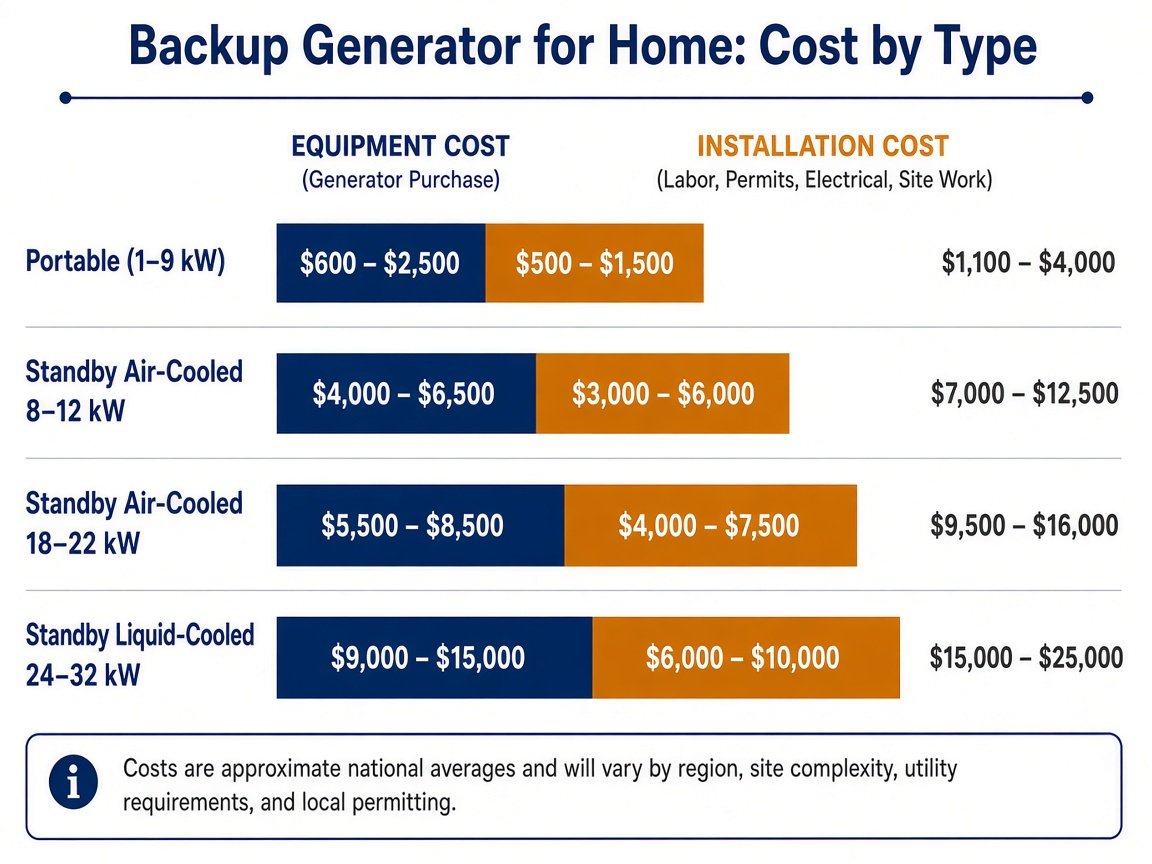
The backup generator for home cost landscape splits into two distinct paths: portable generators you wheel out and manually connect, and standby generators permanently installed beside your home that start automatically within seconds of a power outage. According to HomeGuide’s 2026 cost research, the all-in price for a home backup generator — equipment plus installation — typically spans $800 to $20,000 depending on which path you take. The table below maps the full range by generator type and capacity.
| Generator Type | Equipment Cost | Installation Cost | Typical All-In Budget |
|---|---|---|---|
| Portable (1–9 kW) | $400–$2,500 | $150–$500 (interlock kit) | $550–$3,000 |
| Standby, air-cooled (8–12 kW) | $2,500–$4,000 | $2,500–$4,500 | $5,000–$8,500 |
| Standby, air-cooled (18–22 kW) | $3,500–$6,000 | $4,000–$5,000 | $7,500–$15,000 |
| Standby, liquid-cooled (24–32 kW) | $6,000–$12,000 | $4,500–$6,000 | $10,500–$18,000 |
Cost ranges compiled from HomeGuide and StandbyGeneratorGuide, 2026. Actual costs vary by region, local labour rates, and site complexity.
These figures are frameworks, not quotations. Local labour markets, the distance from your gas main to the generator pad, soil conditions for the electrical trench, and municipal permit fees all move the final number. Northern states with stricter code enforcement and higher electrician rates tend to sit toward the top of these ranges; rural areas in the South and Midwest often come in lower. The table sets the right expectations — the contractor’s site visit sets the actual price.
What Types of Backup Generators Are Available for Homes?
Understanding the options is the first step toward an accurate budget. The three main categories differ sharply in upfront cost, convenience, and long-term value. The right choice depends on your outage history, your critical loads, and your appetite for manual involvement during a power emergency.
Portable Generators
Portable generators are the most affordable entry point into home backup power. You fill them with gasoline, start them manually, and run extension cords or connect them through a transfer switch. They work well for powering a refrigerator, a few lights, and device charging during short outages. The main tradeoffs are the manual setup, noise level, and the need to store fuel safely. For homeowners in areas that see one or two brief outages per year, a well-matched portable generator for home backup can be the most cost-effective solution available — without the five-figure installation commitment.
Air-Cooled Standby Generators
Air-cooled standby generators in the 7–22 kW range are the most common choice for single-family homes. They connect to a natural gas or propane line, start automatically within seconds of detecting a power outage, and can run for days without manual intervention. Generac, Kohler, and Cummins dominate this segment. This is the category most homeowners mean when they say “whole-house generator,” though a 10–13 kW unit may actually cover only essential circuits rather than the whole home — a distinction worth understanding before you shop.
Liquid-Cooled Standby Generators
Liquid-cooled generators rated at 24 kW and above are engineered for large homes, properties with heavy HVAC loads, or situations where uninterrupted whole-house power is non-negotiable. They are designed for extended run times and commercial-grade reliability under sustained load. The price premium over air-cooled units is significant — often $5,000 to $8,000 more all-in — but their rated output and service life justify the gap for the right application. They are overkill for most standard residential use cases.
What Factors Drive the Cost of a Home Backup Generator?
Generator pricing is not random. Several concrete variables push your quote in a predictable direction. Knowing them before you call contractors lets you have a sharper conversation and avoid surprises that only appear after the site visit.
- Output (kW): More watts means more cost — both for the unit itself and for the heavier electrical infrastructure required. Each step up in capacity (say, from 13 kW to 22 kW) typically adds $1,500–$3,000 to equipment price alone.
- Fuel type: Natural gas and propane standby units are priced similarly at the unit level. Natural gas saves money long-term because supply is continuous via the utility line, eliminating stored-fuel management. Diesel standby units cost considerably more upfront.
- Transfer switch type: A manual transfer switch costs less but requires you to flip breakers during an outage. An automatic transfer switch (ATS) adds $400–$900 for the component and is standard on all standby installations — it handles the switchover without any action from the homeowner.
- Site complexity: A generator on a flat lot with an adjacent gas line is straightforward to install. A sloped site, a long electrical trench, or hard-to-access gas piping adds labour hours — and cost — to any quote.
- Permit fees: Most jurisdictions require both an electrical and a gas permit for standby generator installation. Fees vary from under $100 to several hundred dollars depending on your municipality and system size.
- Brand and model tier: Generac, as the market volume leader, is widely available and competitively priced. Kohler and Cummins command a moderate premium, reflected in their dealer and service infrastructure.
How Much Does Home Generator Installation Add to the Total Cost?
Installation is the part of the backup generator for home cost that most online calculators underplay. For a standby system, installation consistently adds $3,000 to $5,000 to the unit price according to HomeGuide’s 2026 data — and that figure assumes a relatively uncomplicated site. What goes into a standard standby installation covers more ground than most homeowners expect. For a thorough line-item walkthrough of every cost involved, the complete home generator installation cost guide on Generator Junkie covers the full picture from pad to permit.
A standard standby installation typically encompasses the following scope:
- Concrete or composite pad: The generator needs a level, permanent surface rated for its weight. Pre-cast composite pads cost less than poured concrete and are increasingly common for residential installs.
- Automatic transfer switch (ATS): Mounted in or adjacent to your electrical panel, the ATS detects a utility outage and starts the generator. It also electrically isolates your home from the grid — a code requirement that protects utility workers during restoration.
- Gas line connection: A licensed gas fitter runs a new supply line from your existing gas service to the generator location. Pipe length, diameter, and any required pressure regulators affect this cost.
- Electrical wiring and conduit: The generator output must be safely routed through the ATS into your panel. This work is governed by the National Electrical Code and your local amendments.
- Permits and final inspection: Both gas and electrical permits are typically required. The final inspection is what authorises the system for legal use in your jurisdiction.
Portable generator setups cost considerably less. A transfer interlock kit — a metal bracket that prevents your main breaker and generator breaker from being energised simultaneously — runs $150 to $500 installed by a licensed electrician. It is code-compliant in most areas and is the lower-cost alternative to a full transfer switch for homeowners who are comfortable with the manual connection process.
How Do You Calculate the Right Generator Size for Your Home?
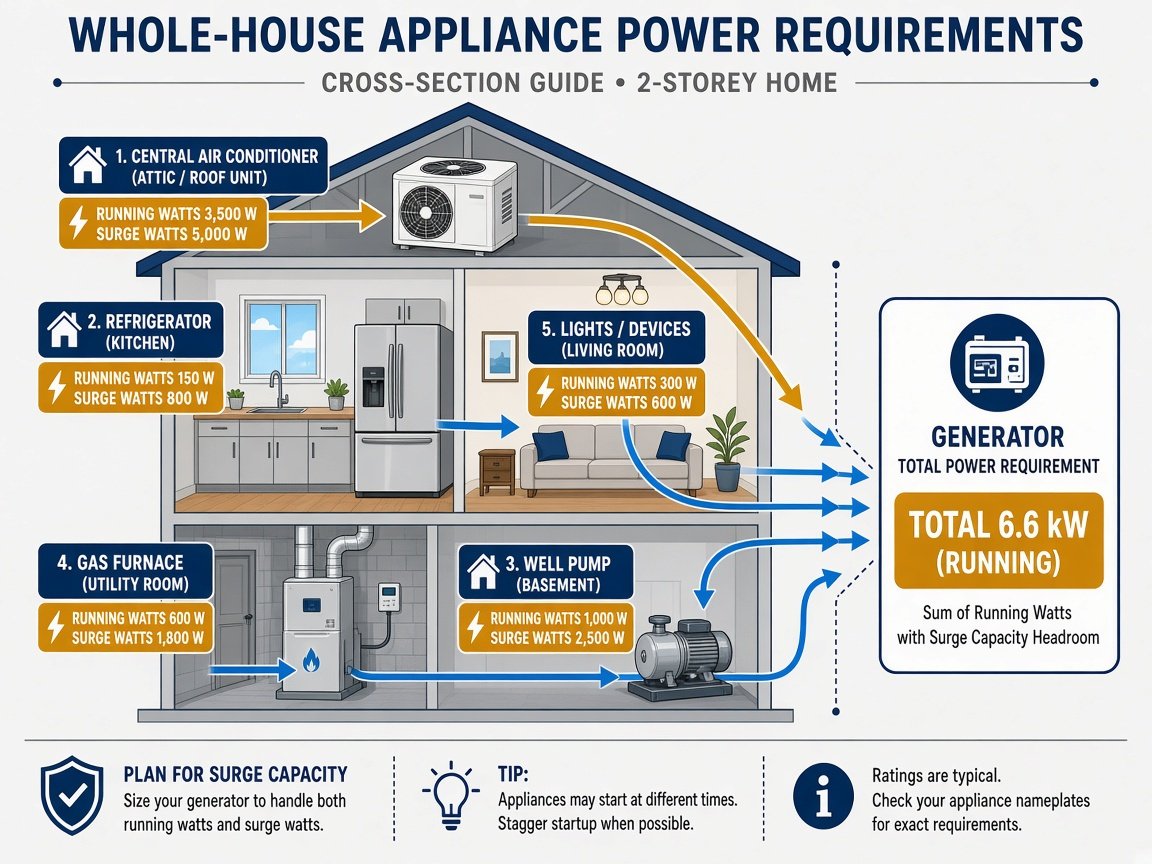
Sizing is where many homeowners either overpay for capacity they will never use, or under-buy and find themselves unable to run the air conditioning alongside the refrigerator. The two most common mistakes are defaulting to a whole-house system when partial coverage would do, and failing to account for the surge wattage of motor-driven appliances at startup.
Not every home needs to run every circuit through a power outage. A partial home generator strategy — covering the refrigerator, well pump, furnace, a few lights, and device charging — can be achieved with a 10–13 kW standby unit at a substantially lower installed cost than a whole-house 22 kW system. For most households, this is a sensible middle ground worth exploring before committing to the larger unit.
A Basic Sizing Approach
- List every appliance you need during an outage. Include the well pump, refrigerator, HVAC system, sump pump, and any medical equipment. Be specific — not “lights” but which circuits.
- Find the running wattage for each item. This is printed on the appliance nameplate or in the owner’s manual. Your utility bills can also help you estimate average consumption.
- Apply a surge factor for motor-driven equipment. Air conditioners, well pumps, and refrigerator compressors draw 2–3 times their running wattage at startup. Use the highest surge wattage, not the running figure, as your capacity ceiling.
- Add a 20% buffer above your total calculated load. Running a generator at or near its rated capacity accelerates engine wear and increases fuel consumption. Headroom is not wasted — it is protection.
- Match to a standard kW tier. Common residential standby sizes are 7.5, 10, 13, 16, 18, 20, and 22 kW. Choose the tier at or above your calculated requirement.
What Are the Ongoing Operating Costs to Budget For?
The purchase and installation price is not the end of the financial story. A standby generator is a mechanical system with a combustion engine, and it carries real ongoing costs that belong in any honest budget. According to GeneratorAdvice’s 2026 running cost data, a typical 22 kW standby generator costs $600 to $1,000 per year to operate in a normal year — and two to three times that in a heavy outage year. Here is where those costs originate.
Annual Professional Maintenance
An annual service visit from a certified technician typically costs $200 to $650 depending on the brand and your region, according to EcoFlow’s maintenance cost research. The standard service covers an oil and filter change, spark plug inspection, battery test, coolant level check (on liquid-cooled units), and a full system exercise under load. Some manufacturers require annual servicing to keep the warranty valid — skipping it may void coverage. This is not optional maintenance for a system you depend on.
Fuel Costs During Outages
Fuel costs are variable but significant. A 20 kW generator running under load on liquid propane consumes roughly 2 to 3 gallons per hour according to EcoFlow’s fuel consumption analysis — translating to approximately $50 to $100 per day of continuous operation at current LP prices. Natural gas generators draw from the utility line at a metered cost with no stored-fuel management, making the per-day figure more predictable and typically lower. For a detailed side-by-side comparison of costs across fuel types, the portable generator fuel cost guide on Generator Junkie breaks down diesel, gasoline, and propane operating economics in full.
Battery and Minor Parts Replacement
The starter battery in a residential standby generator typically needs replacing every three to five years. A replacement battery for a standard standby unit runs $60–$120 for the part, plus labour if you are not comfortable performing the swap yourself. Setting aside $75 to $100 per month in a sinking fund covers the annual service call, the battery replacement cycle, and typical fuel usage during the weekly auto-exercise cycle that most standby generators run by default.
How Does Fuel Type Affect the Total Cost of Ownership?
Fuel choice has a larger impact on long-term backup generator for home cost than many buyers realise at the point of purchase. The unit price difference between a natural gas and a propane standby model is minimal — but the operational differences compound over years of service, particularly in areas that experience extended outages.
- Natural gas: No stored fuel to manage, no delivery logistics, and no run-out risk during extended outages. If your home is already on a gas line, natural gas is almost always the lowest-friction, lowest-operating-cost option for a standby system. Supply is continuous regardless of outage duration.
- Liquid propane (LP): Works reliably where natural gas is unavailable. You will need a 100–500 gallon tank on your property. Tank rental or purchase, annual delivery contracts, and a fuel monitoring system all add to the ongoing cost picture. That said, propane burns cleanly and stores reliably for extended periods.
- Gasoline: The standard fuel for portable generators. Stored gasoline degrades within weeks to months without a stabiliser, and during extended regional outages, filling stations frequently run dry or lose power themselves. Best suited to short-duration backup needs.
- Diesel: Diesel’s high energy density makes it a strong choice for large standby systems and commercial-grade applications. Higher unit cost and tighter emission regulations in some states are the primary tradeoffs for residential use.
Homeowners without an existing gas line sometimes explore solar-plus-battery backup as a complement or alternative to a generator for shorter outages. For those who want maximum fuel flexibility without committing to a single source, dual-fuel and tri-fuel portable generators bridge the gap between full standby capability and practical portability.
Which Generator Brands Offer the Best Value for Money?
Brand choice is a real cost variable in any backup generator for home budget. The three names most consistently quoted by certified installers for standby systems are Generac, Kohler, and Cummins. For portable generators, Honda, Champion, and Westinghouse have strong owner review records across a wide price range. The right choice depends partly on which brands your local certified installer supports — a generator is only as good as the technicians available to service it within a reasonable distance.
Generac
Generac holds the largest share of the residential standby generator market in North America and benefits from the widest dealer and parts availability of any brand in the category. According to HomeForifyROI’s 2026 installed price guide, a Generac 22 kW whole-home standby generator installed on natural gas — including the automatic transfer switch, electrical permit, and gas line connection — typically costs $7,500 to $11,000. Their 7–24 kW product range covers the full spectrum of residential applications. For a detailed look at Generac’s current model lineup and pricing, the Generac generator cost guide on Generator Junkie covers every tier from entry-level to premium.
Kohler
Kohler standby generators carry a moderate price premium over comparable Generac units, with installed costs for equivalent whole-house systems running $8,000 to $12,000 according to HomeForifyROI’s data. Kohler is well-regarded among installers for engine build quality and design precision. Their dealer network is somewhat smaller than Generac’s nationally, which can affect service response time in rural areas. The Kohler whole house generator guide on Generator Junkie walks through the full range, standout models, and what to verify before purchase.
Cummins
Cummins (which now includes the Briggs & Stratton residential standby line) positions its residential products as commercial-grade reliability at a consumer-accessible price point. Pricing is broadly comparable to Kohler at equivalent capacity levels. The PowerCommand monitoring system, which allows remote status monitoring via a mobile app, is frequently cited in owner reviews as a standout feature for homeowners who want real-time visibility into their generator’s readiness.
What Hidden Costs Do Homeowners Typically Overlook?
Even well-prepared homeowners are sometimes caught off-guard by line items that did not appear in their initial contractor quote. These are not surprises engineered by contractors — they are legitimate site and regulatory requirements that vary too much to quote without a site visit. Building them into your budget before you get quotes prevents frustration later.
- Utility notification: Most utilities require written notification before you connect a standby generator to your home’s service entrance. Some perform their own inspection. This is typically free but can add several weeks to the installation timeline.
- HOA approval: Many homeowners associations have placement restrictions for standby generators — setback requirements from property lines, enclosure rules, or noise ordinances. Securing written approval before installation prevents costly repositioning later.
- Propane tank installation: If you are going the propane route without an existing tank, budget $400–$2,500 for tank purchase, or $50–$150 per year for rental, plus the initial propane fill to get the system operational.
- Landscaping restoration: Electrical trench work disrupts grass, garden beds, or hardscaping. Restoration is typically outside the scope of a generator contractor’s quote and falls to the homeowner to arrange separately.
- Extended warranty or service contract: Manufacturer warranties on residential standby generators are typically five years on parts and two years on labour. Dealer-offered extended service plans add $100–$300 per year but can provide meaningful value for a system you depend on during emergencies.
- Homeowner’s insurance update: A permanently installed standby generator is a material home improvement that should be declared to your insurer. Some carriers apply a home improvement discount; failing to disclose can complicate a future claim. The call takes minutes.
Is a Backup Generator Worth the Investment for Your Home?
The return on a backup generator for home is not purely financial — but the financial case is stronger than many homeowners expect. A permanently installed standby generator is recognised in the remodelling and real estate industries as a home improvement that adds measurable resale value, particularly in regions where severe weather outages are a known and recurring risk. The magnitude of that increase varies by market, but the feature registers as a positive for buyers in storm-prone coastal, hurricane-corridor, and rural well-water markets.
The more concrete argument, for many households, is continuity cost avoidance. A refrigerator and chest freezer full of food spoils in roughly four hours without power — a loss that runs into several hundred dollars for a single multi-day outage. For households with a home office, remote work dependencies, medical equipment, or a property served by a well pump, the value of uninterrupted power is not abstract. As an illustrative frame only: a household that suffers two days of lost work and $400 in spoiled food during a single extended outage has a clear reference point for what a $600–$1,000 annual operating cost is actually protecting against.
For homeowners not ready to commit to a full standby system, a well-chosen portable generator covers the critical bases at a fraction of the cost — particularly in areas where outages are infrequent or short. The goal is matching the solution to your actual risk and usage pattern, not buying more generator than your situation requires.
Frequently Asked Questions About Backup Generator for Home Cost
What is a reasonable all-in budget for a home backup generator in 2026?
For a portable generator covering critical appliances, budget $550–$3,000 all-in. For an air-cooled standby system sized for a typical single-family home, the realistic all-in budget in 2026 is $7,500–$15,000, based on HomeGuide and StandbyGeneratorGuide cost data. Liquid-cooled systems for large homes can reach $18,000 or more installed.
Can I install a home backup generator myself to save money?
The mechanical side of a portable generator interlock kit is within reach of a confident DIYer, but the electrical portion must still be completed by a licensed electrician in most jurisdictions. Standby generator installation involves gas piping, automatic transfer switch wiring, and local permits that require licensed contractors by code. Unpermitted generator work can void your homeowner’s insurance and create serious ongoing safety risks — it is not a shortcut worth taking.
How long does a home standby generator last?
Air-cooled residential standby generators are typically rated for 10,000–15,000 hours of engine life under normal load conditions. With typical residential use — a few hundred hours per year during outages plus weekly auto-exercise cycles — a well-maintained unit can serve a home for 20 to 30 years. Annual professional servicing is the single biggest determinant of whether a unit reaches the upper end of that range.
Does a whole-house standby generator run on natural gas or propane?
Most residential standby generators are designed to run on either natural gas or liquid propane — the same unit can typically be configured for either fuel with an included conversion kit or regulator swap. Natural gas is preferred where available because supply is continuous and there is no tank to manage or refill. Propane is the standard choice where natural gas service does not reach the property.
What size generator do I need for a 2,000 square foot house?
A 2,000 sq ft home with central air conditioning, a gas furnace, a refrigerator, and a well pump generally requires 14–18 kW to run all systems simultaneously. If you are prepared to run without central AC or manually cycle loads, a 10–13 kW unit may suffice and costs noticeably less. A certified installer can conduct a load assessment for your specific appliances before you commit to a capacity tier.
Does adding a standby generator increase home resale value?
A permanently installed standby generator is generally recognised as a value-adding home improvement, particularly in regions with frequent power outages or high exposure to severe weather. The resale uplift varies by market, but the feature is considered a meaningful positive by buyers in storm-prone, coastal, and rural markets where backup power is a known practical need rather than a luxury.
How often does a standby generator need to be serviced?
Most manufacturers recommend annual professional servicing for residential standby generators, plus a visual inspection after any extended run period. Many units also run an automatic weekly self-test that exercises the engine under no load. Annual service visits, which cover oil, filters, battery, and a full system check, typically cost $200 to $650 depending on the brand and your region.
What Should You Do Next?
Getting the right backup generator for home starts with matching the solution to your actual risk and budget — not defaulting to the most powerful unit on the shelf. Here is a practical sequence to follow from research through installation.
- Audit your critical loads. Write down every appliance you need during an outage and find the running and surge wattage for each. This takes under an hour and anchors every decision that follows.
- Decide: portable or standby? If outages in your area are short and infrequent, a quality portable generator may fully cover your needs. If outages are frequent, long, or your household has medical or water supply dependencies, the standby economics justify the premium.
- Get at least three installation quotes. Prices vary significantly between contractors for identical equipment. Confirm that every quote includes permits, the ATS, the gas line connection, the pad, and the final inspection fee — not just the generator unit.
- Verify local brand service coverage. The best-spec’d generator is the wrong choice if there are no certified service technicians within a reasonable distance. Ask each contractor which brands they are certified to service before you buy.
- Build your ongoing cost budget. Set aside for the annual service call. If you are on propane, factor in tank rental and delivery scheduling. A monthly sinking fund of $75–$100 covers most recurring costs for a typical standby system.
The Generator Junkie editorial team covers every dimension of this decision — from individual brand deep-dives to storm preparation and fuel management. Use the resources linked throughout this guide to build a complete, confident picture before you spend a dollar.