
You know that portable generator you’re eyeing for the storm?
Turns out it could actually cause carbon monoxide poisoning if it’s not placed right—like, inside the garage.
Running a generator indoors or in an attached garage can quickly cause carbon monoxide poisoning.
A portable generator might keep your fridge running for a few hours, but it can run out of fuel or fail mid-storm, which is a serious problem if someone depends on powered medical devices.
But my standby generator? Never even flickered.
Seriously, why do we keep guessing?
Can a Portable Generator Keep Your Fridge Running?
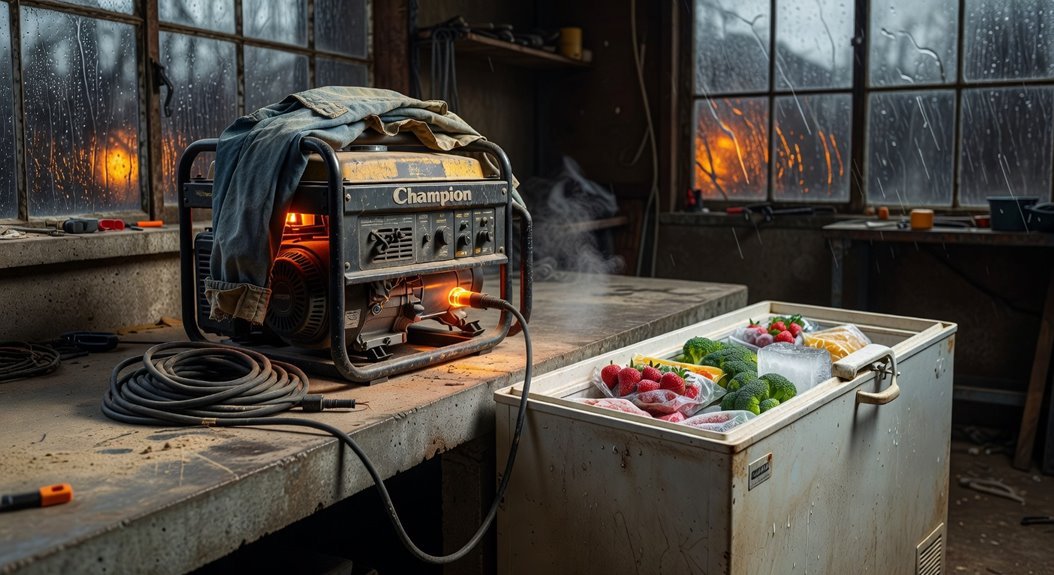
Can a portable generator run your fridge during an outage? Yes, as long as it’s big enough. A typical refrigerator draws a few hundred watts while running and more for a moment when the compressor starts, so check the label and choose a generator that covers that starting surge. A very small unit, around 600W, won’t cope. Fuel use adds up quickly if you run the generator around the clock just for the fridge. Always keep it at least 20 feet from the house, because carbon monoxide is deadly. A portable is a short-term fix for a fridge, not a long-term solution.
Regular maintenance and a clear maintenance schedule keep your generator ready for emergencies.
400 Vs $2,700: What Really Matters for Your Power Needs
| Feature | Portable ($2,700 max) | Standby ($5,000+) |
|---|---|---|
| Initial Cost | $400-$2,700 | $5,000+ |
| Power Output | 1,000-6,500W (not whole home) | 8,000-22,000W (whole home) |
| Automation | Manual start (no backup) | Automatic (seamless shift) |
| Fuel Run Time | Gasoline: 12-20 gal/day | Propane: Days/weeks |
| Install Cost | +$1,175-$1,515 (transfer switch) | Included in base price |
A transfer switch ensures a seamless shift during outages and aligns with proper installation and safety.
Why That $500 Portable Generator Might Get You Sick?

Remember that $2,700 portable generator we discussed? Let’s focus on the $500 model tempting you. Forget the savings—it’s a safety hazard. Many cheap units lack CO sensors, risking carbon monoxide poisoning while you try to keep the lights on. Seriously, don’t gamble with your health.
Comparing costs, those $500 generators typically max out at 2,500–3,500 watts, requiring constant appliance switching. You’ll burn 12–20 gallons of gas daily, making fuel costs unsustainable. Their short 500–1,000-hour lifespan means replacing them sooner than expected. Safety risks extend beyond CO—these units are inherently flimsy. Investing more upfront avoids daily hassles and health dangers. It’s not just power; it’s smart, safe innovation.
Will a Whole-House Generator Power Your Medical Devices?
Imagine your CPAP machine losing power during a storm while you sleep—basic power becomes critically personal, not just about charging devices. Whole-house generators *can* support medical devices, but it’s not simply plugging in. They typically deliver 8k-22k watts, sufficient for devices like oxygen concentrators. However, medical device compatibility requires professional installation. An electrician must properly wire the system, especially for 240V setups. Surge protection is non-negotiable—not optional—to shield life-sustaining equipment. Poor grounding can cause damage, and a transfer switch is essential to prevent damaging surges. While a whole-house generator may power your medical device, improper installation or omitted surge protection creates significant risk. It’s not merely about voltage; it’s about safety. Ensure professional engineering for reliable, safe operation.
3,500 Vs $6,000: Why the Price Difference Isn’T Just Parts
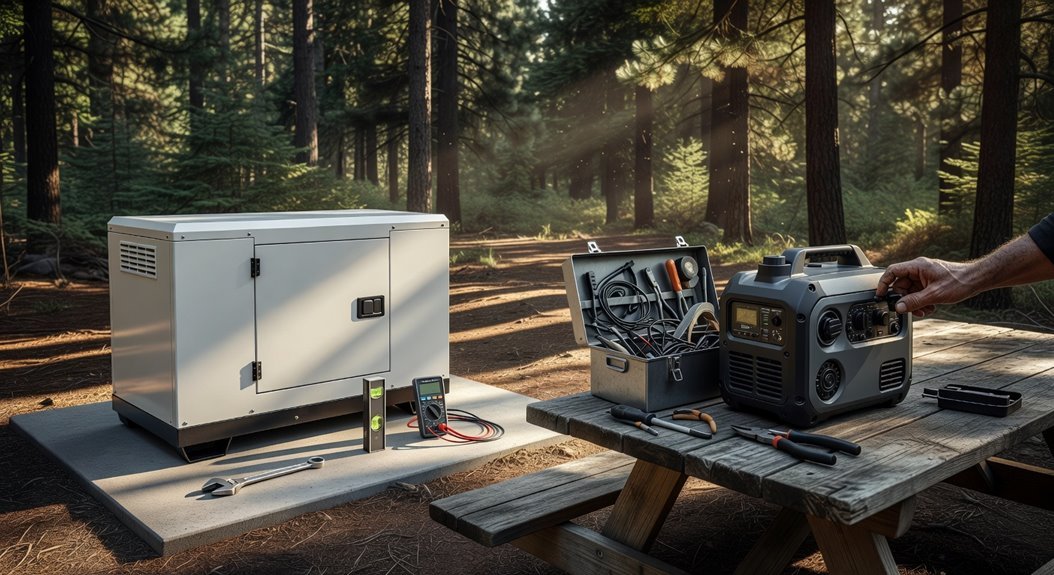
So why does a portable feel so different from a standby system? A portable costs a few hundred to a couple of thousand dollars, while a standby system costs several thousand once you add the transfer switch and professional installation, plus fuel costs while it runs. What you pay for is hands-off, whole-house power that starts automatically. For homes where critical systems can’t go without power, that’s often worth it.
Why Your Neighbor’s Backup Plan Failed During the Blackout
A small portable generator can let you down in a long outage. It needs refueling every several hours, skipped maintenance can clog the fuel filter, and it won’t start itself when the power fails. A standby generator starts automatically and runs on natural gas or propane through an extended outage without refueling trips. If you depend on backup power, choose a system built for long outages, not just the first few hours.
Frequently Asked Questions
Should I Get a Portable or Standby Generator?
Choose a portable generator for basic needs like a fridge and lights during short outages. Portable models range from $400 to $2,700, while standby units cost $3,500 or more upfront. Portable is more cost-effective for small appliances. For automatic whole-house power, standby offers long-term value. For most users, portable is the practical starting point.
What Are the Disadvantages of a Standby Generator?
Standby generators have a higher upfront cost than portables once you include the transfer switch and installation, plus annual maintenance. They’re designed for reliable performance, but like any machine they can develop unexpected issues.
Can a Portable Generator Be Used as a Standby Generator?
Portable generators are not designed for standby use. Their maximum capacity of 8,500 watts typically cannot meet larger power demands, requires frequent refueling, and necessitates a transfer switch costing $1,175–$1,515. Standby generators automatically manage power restoration, while portable units serve as a temporary solution rather than a reliable long-term alternative.
What Are the Disadvantages of a Portable Generator?
Portable generators are generally impractical for regular use due to limited power output—typically capping at 8,500 watts, which prevents running all appliances simultaneously. Fuel consumption is significant, requiring frequent refueling (e.g., 5–10 gallons per 8-hour run), increasing operational costs. They require manual starting and maintenance, generate high noise levels (60–70 dB), and remain susceptible to power surges that may damage electronics. Compared to standby systems, portable generators often prove less cost-effective over time.
Pingback: Power up With Generac Quietsource Generators - Generator Junkie
Pingback: Gas Generator Buying Guide: Choose the Right Power