Home generator installation cost ranges from $3,000 to $15,000 for a whole-house standby system — or as little as $200 to $600 to connect a portable unit through a transfer switch. The gap is that wide because four independent cost drivers all vary at once: the generator unit itself, the transfer switch, labor rates, and fuel-source infrastructure. Understanding each one before you call a contractor puts you in control of the final number.
Executive Summary: Key Cost Numbers for 2026
- The average whole-home standby installation lands between $4,500 and $10,000, covering the unit, transfer switch, labor, and permits.
- Labor accounts for 30–45% of most installation budgets, with licensed electricians billing $75–$150 per hour and most jobs requiring 8–16 hours on site.
- Fuel-source preparation — extending a natural gas line or installing a propane tank — adds $500 to $3,500 to your total, depending on existing infrastructure.
- Homeowners who size their generator correctly before buying avoid the single most common cause of cost overruns: purchasing an undersized unit and paying full installation costs again to upgrade within two years.
What Is the Total Cost to Install a Home Generator in 2026?
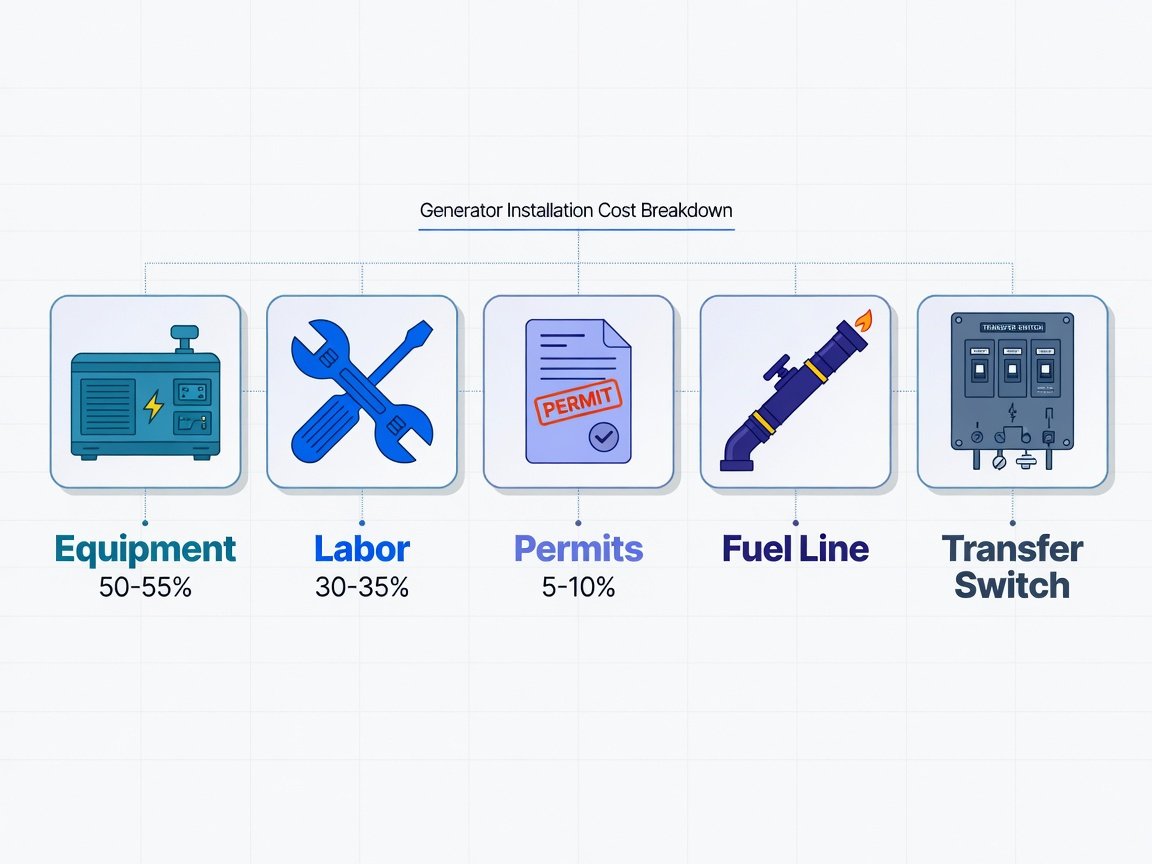
The clearest way to frame total installation cost is to separate what you pay for equipment from what you pay to put it in the ground. Industry cost data for 2026 shows a typical standby generator project breaks down roughly as follows: 50–55% equipment, 30–35% labor, and 10–15% permits, materials, and infrastructure. For a mid-size 14kW–18kW system — which covers most 2,000–3,000 sq ft homes — you should budget $6,000–$9,500 all-in.
Portable generator hookups sit at the other end of the price spectrum. If you already own a portable unit, a licensed electrician can install a manual transfer switch for $200–$600 in labor and parts. An automatic transfer switch, which senses a power failure and switches circuits without any action on your part, adds $500–$1,500 to that figure. The trade-off is permanent, hands-free monitoring — and the peace of mind that comes with waking up to a running house after a midnight outage.
What Factors Drive Generator Installation Costs Higher?
No two installations carry the same price tag, and the variables that push costs up are predictable once you know where to look. Generator size is the biggest lever: every additional kilowatt of output adds roughly $150–$250 to the unit cost and puts more demand on the wiring, the transfer switch, and sometimes the electrical panel. A 10kW unit might clear $2,500 while a 22kW whole-home unit sits above $5,500 — and that gap multiplies across labor hours too.
Property layout matters almost as much. A generator placed close to the electrical panel and an existing gas meter keeps labor hours low. Move it 50 feet away to comply with local setback rules — most municipalities require 5–18 feet of clearance from doors, windows, and property lines — and you’re looking at longer conduit runs, extended gas piping, and an extra $400–$1,200 in installation time. Older homes with undersized electrical panels often require a full panel upgrade before any generator work can begin, adding $1,500–$4,000 to the project budget before the generator is even on site.
| Cost Component | Low Estimate | High Estimate | Key Variable |
|---|---|---|---|
| Generator unit (10kW–22kW standby) | $2,000 | $6,000 | Brand, kW rating, fuel type |
| Transfer switch — manual | $200 | $600 | Portable hookup only |
| Transfer switch — automatic (ATS) | $500 | $1,500 | Required for all standby units |
| Labor — electrical installation | $1,200 | $3,500 | 8–16 hours at $75–$150/hr |
| Concrete pad or gravel base | $150 | $500 | Required by most local codes |
| Natural gas line extension | $500 | $2,000 | Run distance from meter |
| Propane tank installation | $800 | $3,500 | Tank size; buried vs. above-ground |
| Permits and inspections | $50 | $400 | Varies heavily by municipality |
| Electrical panel upgrade (if needed) | $1,500 | $4,000 | Older homes most at risk |
How Much Do the Generator Unit and Transfer Switch Cost?
The generator unit is almost always the largest single line item on the invoice. Air-cooled standby generators — the type most commonly installed in residential applications — run from roughly $2,000 for a 10kW unit to $6,000 for a 22kW unit at retail. Liquid-cooled models designed for very large homes or properties requiring 25kW and above can push past $10,000 for equipment alone, before a single hour of labor is billed.
Generac dominates the residential standby market with roughly 70% market share in 2026, followed by Kohler, Briggs & Stratton’s Standby line, and Champion. Each brand prices at slightly different points, and dealer markup varies by region. For a complete breakdown of what Generac models cost at each kilowatt tier, the detailed Generac generator pricing guide on Generator Junkie covers every unit from the 10kW Guardian to the 26kW liquid-cooled flagship.
One nuance buyers consistently miss: the price listed on a retailer’s website almost never includes the automatic transfer switch, which is sold separately. Add $400–$900 for the switch panel and you’re already $500+ above the sticker price before the installer arrives. Always request an all-in equipment quote that line-items the generator, transfer switch, mounting hardware, and accessories separately — that’s the only number you can meaningfully compare across contractors.
What Are the Labor Costs for Generator Installation?
Labor is where homeowners are most often surprised. Licensed electricians billing at $75–$150 per hour and licensed plumbers or gas fitters billing at $65–$130 per hour each need to be on site during a full standby installation. A clean, straightforward job — new home, panel nearby, gas meter close, no panel upgrade — might land in the 8–10 hour range. A more complex install with a long conduit run, a buried propane tank, and an older panel easily stretches to 14–20 hours total across both trades.
Generator installation is not a DIY project in most U.S. jurisdictions. Most states require a licensed electrician to make the electrical connections and a licensed plumber or gas fitter to connect the fuel supply. Attempting either without a license voids homeowner’s insurance coverage, creates personal liability in the event of a fire, and fails to meet the National Electrical Code requirements that protect utility workers servicing lines near your home. The labor cost is not optional — it is the cost of a safe, code-compliant, insurable installation.
Many homeowners budget only for the electrician but forget that a licensed plumber or gas fitter must run and pressure-test the fuel supply line separately. This trade typically bills $400–$900 for a standard residential gas connection — a line item that surprises a significant share of first-time buyer-installers.
What Permits and Inspections Does Generator Installation Require?
Permit requirements vary by state and municipality, but most jurisdictions require at least two permits for a standby generator installation: an electrical permit and a gas or mechanical permit. Fees range from $50 in rural counties to over $400 in dense urban markets. Some municipalities fold both permits into a single “generator installation permit” with a flat fee; others process them independently through separate building departments.
Beyond the permits, plan for at minimum two inspections: one rough-in inspection before conduit is closed, and one final inspection after the system is fully operational and load-tested. Failing an inspection typically means a re-inspection fee of $50–$150 and a delay of one to three weeks. A reputable installing contractor will pull the permits on your behalf, schedule the inspections, and warranty the work against code deficiencies. This service is included in professional installation quotes — and is one reason the lowest-bid contractor is not always the best value.
Does Your Fuel Source Affect Installation Cost?
Fuel source is one of the most significant and least discussed installation cost variables. Natural gas is the lowest-friction option if you have an existing gas meter with adequate supply pressure — the gas fitter simply extends the supply line to the generator pad, costing $500–$2,000 depending on the run distance. Most residential gas services handle a 10kW–18kW generator without upgrades; larger units may require the utility to upsize your meter, a process that can take 4–8 weeks and add $300–$800 in utility fees.
Propane is the go-to fuel where natural gas is unavailable or too distant from the generator location. An above-ground 120-gallon tank runs $800–$1,200 installed; a 500-gallon above-ground tank — better suited to a 16kW+ unit that may run for days after a major storm — runs $1,200–$2,000 installed. Buried 500-gallon and 1,000-gallon tanks cost $2,000–$3,500 due to excavation requirements. Propane also costs significantly more per BTU than natural gas at prevailing 2026 prices, so the fuel cost gap compounds quickly during extended outages. For a detailed side-by-side breakdown of how generator fuels compare over time, the portable generator fuel cost comparison guide runs the numbers across real usage scenarios.
How Does Generator Size Affect Your Installation Budget?
Getting the size right before buying is the single most powerful cost-control decision you make. An undersized generator struggles under load, trips on overload, and often gets replaced within two years — at full installation cost again. An oversized unit wastes money upfront and burns excess fuel every time it runs its weekly self-test. The sweet spot is matching rated output to your actual critical load with a modest headroom buffer of 10–20%.
Industry sizing guidelines suggest a 10kW unit for essential circuits in a 1,500 sq ft home, a 14kW–16kW unit for whole-home coverage of a 2,000–2,500 sq ft home, and a 20kW–22kW unit for homes over 3,000 sq ft or those with central electric HVAC. Before finalizing a size, add up starting wattage — not running wattage — of everything you want powered simultaneously, because motor-driven appliances draw 2–3× their running watts at startup. The step-by-step home backup generator sizing process walks through this calculation with a printable load worksheet.
Budget roughly $500–$800 extra for each kilowatt step up in size (e.g., from a 14kW to an 18kW unit). That premium covers the larger unit, heavier transfer switch, and additional labor for thicker wiring — and it is almost always cheaper than a full reinstall later.
What Are the Steps in a Professional Generator Installation?
Understanding the installation sequence helps you verify that your contractor is working to code and keeps you from being surprised by intermediate costs or delays. A complete standby generator installation follows a consistent eight-step sequence regardless of brand or fuel type.
- Site assessment and load calculation — The electrician reviews panel capacity, measures all relevant distances, and calculates your critical load. This is typically performed during the free estimate visit at no charge.
- Permit application — Your contractor submits electrical and gas permits to the local building authority. Allow 3–10 business days for approval in most markets; high-demand metro areas can run longer.
- Generator pad preparation — A concrete pad (minimum 3 inches thick per most local codes) or compacted gravel base is poured or placed at the chosen location, respecting all required setback distances.
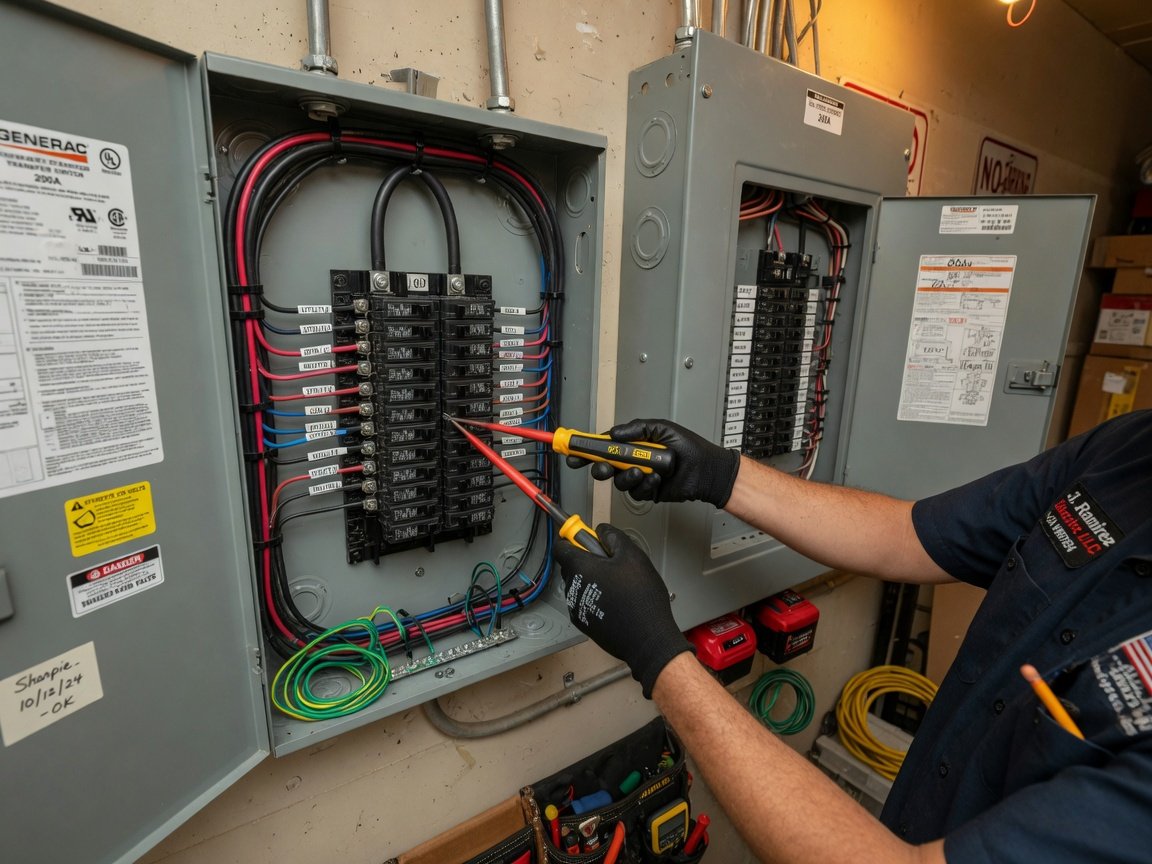
- Electrical rough-in — Conduit and wiring are run from the generator location to the main panel. The transfer switch enclosure is mounted and wired into the load side of the main panel.
- Gas line extension or propane tank installation — The licensed gas fitter extends the supply line or positions and connects the propane tank. All lines are pressure-tested before final connection to the unit.
- Generator unit placement — The unit is placed onto the prepared pad (crane-assisted for larger liquid-cooled models), bolted down, and connected to the electrical conduit and fuel supply.
- Transfer switch wiring and control connections — The generator’s control wiring is run to the automatic transfer switch. Utility-side and generator-side connections are verified for correct phase, polarity, and neutral bonding.
- Inspection, load test, and commissioning — The municipal inspector reviews all connections. The contractor then starts the unit under load, verifies voltage and frequency output, and programs the weekly automatic self-test cycle.
For a deeper look at how the wiring connects — and what makes a safe, code-compliant hookup different from a dangerous backfeed situation — the complete safe-wiring guide on Generator Junkie covers every connection point in plain language.
Can You Legitimately Reduce Home Generator Installation Costs?
There are genuine ways to reduce installation costs without compromising safety or code compliance. The most impactful is choosing the right location at the outset. Placing the generator as close to the electrical panel and gas meter as setback rules allow minimizes conduit runs and gas piping. Every additional 10 feet of gas pipe or electrical conduit adds roughly $100–$200 in materials and labor — a number that compounds fast on long runs. Investing 30 minutes in a pre-purchase site layout consultation can save $500–$1,500 on complex installations.
Bundling related electrical work creates savings too. If your panel already needs an upgrade, scheduling that work in the same contractor visit as the generator installation saves one mobilization fee — typically $150–$300 — and allows the electrician to complete both projects in logical sequence rather than making two separate site visits. Scheduling a fall installation (September through November) rather than reacting to a storm event also tends to unlock more competitive labor rates, because installer demand spikes sharply after regional outages and pricing follows suit.
A partial-home generator configuration is the most meaningful structural cost reduction available. Rather than a full 200-amp whole-home transfer switch, a partial setup powers only the most critical 8–10 circuits — HVAC, refrigerator, well pump, sump pump, lights, and a few key outlets — through a dedicated subpanel. This allows a smaller, less expensive unit to do the job effectively while keeping both the generator price and transfer switch costs lower. The Generator Junkie guide on what a partial home generator covers explains the circuit-selection logic and how to identify your true essential load.
What Does a Real 2026 Installation Actually Cost? A Case Study
A homeowner in suburban North Carolina — a 2,400 sq ft two-story home built in 2001 with a 200-amp panel — recently documented a full standby generator installation from first call to final inspection. Their goal was whole-home coverage including central air conditioning and a natural gas range. The home had an existing gas meter 22 feet from the chosen generator location, clear sightlines to the panel, and no panel upgrade requirement.
| Line Item | Cost Paid |
|---|---|
| Generac 18kW Guardian unit (retail) | $4,100 |
| 200-amp automatic transfer switch | $850 |
| Labor — licensed electrician (12 hrs at $110/hr) | $1,320 |
| Labor — gas fitter (4 hrs at $95/hr) | $380 |
| Concrete pad and anchoring hardware | $275 |
| Natural gas line extension (22 ft run) | $640 |
| Permits and inspections (two permits) | $185 |
| Total Project Cost | $7,750 |
The installation came in close to the 2026 national median, with one minor unplanned cost: a $200 charge to relocate a gas shut-off valve that sat directly in the conduit path — a condition discovered during rough-in that the electrician flagged before proceeding. Total project timeline was 19 days from first contact to final inspection sign-off, with all physical work completed in a single day. The homeowner reported the generator has since run two self-tests and responded correctly to one brief utility outage.
Is a Portable Generator a More Affordable Alternative?
For homeowners not yet ready for a $7,000–$10,000 standby investment, a quality portable generator paired with a proper transfer switch delivers meaningful backup power at a fraction of the cost. A dual-fuel 9,500W portable generator costs $800–$1,400, and a manual transfer switch installation adds $350–$600 in labor and parts. Total realistic outlay: $1,200–$2,000 — roughly one-fifth the cost of a mid-size standby system.
The trade-offs are real. Portable units require manual setup every time the power goes out — fueling, starting, and physically connecting to the transfer switch — which matters most when outages hit at 2 a.m. during a winter storm. They also have shorter run times per tank and require safe fuel storage on your property. For a curated evaluation of the strongest portable options currently on the market, the best portable generators for home backup guide rates the top-performing units by price tier, runtime, and ease of setup.
What Will Home Generator Installation Cost in 2027?
Two converging trends are likely to push installation costs modestly higher through 2027. First, demand for residential backup power has grown faster than the licensed installer workforce since 2023, and that supply-demand imbalance is not resolving quickly. Areas experiencing frequent severe weather events — particularly the Southeast, the Mid-Atlantic corridor, and parts of the Midwest — are already seeing 15–25% labor premiums for generator work compared to 2024 rates. Contractors in those markets report booking timelines of 6–12 weeks even in non-storm periods — a meaningful constraint for homeowners who wait until the next outage to act.
Second, battery-backup and hybrid generator systems are beginning to compete meaningfully with traditional standby units for wallet share. Whole-home battery systems carry significantly higher upfront installation costs than a gas standby generator, but ongoing fuel costs are lower and maintenance is simpler. The competitive dynamic will likely push traditional generator manufacturers to hold price on equipment as the total-cost-of-ownership comparison becomes more visible to consumers. Homeowners without an urgent need may benefit from watching both technology categories over the next 12–18 months before committing to a system type.
Frequently Asked Questions About Home Generator Installation Cost
How much does it cost to install a whole-house generator?
A whole-house standby generator installation typically costs $4,500 to $15,000 all-in, with the 2026 national average landing around $7,000–$8,000. The range is wide because generator size, fuel infrastructure, local labor rates, and permit costs vary significantly by region and property condition.
Can I install a home generator myself to save money?
No. The electrical connections and gas line work require licensed tradespeople in virtually every U.S. jurisdiction. DIY installation voids your homeowner’s insurance coverage, fails code inspection, and creates genuine safety hazards for you and for utility workers. Labor is a non-negotiable component of any safe, legal, and insurable installation.
Does a home generator increase property value?
Yes, reliably. Industry appraisal data consistently shows that a permanently installed standby generator adds 3–5% to home resale value in markets prone to power outages. In high-frequency outage markets — coastal Florida, the Carolinas, and the Northeast — that premium can approach 5–7% among buyers who actively seek backup power as a purchase criterion.
How long does a home generator installation take?
The physical installation — from generator delivery to a running, load-tested system — typically takes one full day (8–12 hours) for a straightforward standby install. Factor in 3–10 business days for permit approval before the install date, and 3–5 days for the inspection appointment after. Total project timeline: 2–4 weeks from first contact to final sign-off.
Do I need a permit to install a home generator?
Yes, in almost every jurisdiction. Standby generator installations require at minimum an electrical permit and a gas or mechanical permit. Your installing contractor should pull these on your behalf as a standard part of the project. Never hire a contractor who suggests skipping permits — it creates serious liability and can prevent you from closing a future home sale.
What is the cheapest way to get backup power at home?
The most affordable route is a portable generator ($600–$1,400) plus a manual transfer switch installation ($350–$600), for a total of $1,000–$2,000. This setup powers critical circuits during an outage but requires manual startup and fueling. If you want fully automatic backup, a partial-home standby generator covering essential circuits only represents the next step up at roughly $4,000–$6,500 installed.
Does homeowners insurance cover generator installation?
Standard homeowners insurance policies do not cover the upfront cost of installation. However, once installed, a permanently mounted standby generator is generally covered as a permanent structure under your dwelling coverage in the event of fire, theft, or storm damage. Some insurers offer equipment breakdown endorsements that cover mechanical failure. Confirm specifics with your insurer before purchase, as coverage limits and exclusions vary by policy.
The Bottom Line: How to Budget Your 2026 Generator Installation
Home generator installation cost is not a single number — it’s the sum of five independent decisions: generator size, transfer switch type, fuel source, site complexity, and local labor market. Get those five decisions right, and your all-in cost lands in a predictable range. Rush any of them, and you’re likely to pay for the mistake twice.
Follow this sequencing to keep your project on budget and on timeline:
- Calculate your critical load first — know your required wattage before talking to any contractor or browsing units.
- Choose your fuel source based on existing infrastructure — natural gas if you have a meter nearby, propane if you don’t.
- Get three itemized quotes from licensed, insured electrical contractors — unit, transfer switch, labor, infrastructure, and permits listed separately.
- Confirm the permit process with your local building department before signing any contract.
- Schedule off-season where possible — spring or fall installations typically carry better availability and more competitive labor rates than post-storm demand surges.
- Hold a 15% contingency for discovered conditions: undersized panels, longer gas runs, or unexpected setback compliance requirements.
A correctly sized, professionally installed standby generator is one of the highest-confidence home investments available — it protects everything else in the house. The cost is real, but so is the return: in value, in safety, and in the reliability of knowing your home keeps running when the grid does not.