
A Kohler whole house generator is a permanently installed standby unit that detects a grid outage and restores power to your entire home automatically — typically within seconds, with no action required from you. It connects to your home’s natural gas or liquid propane supply and runs for as long as fuel flows, making it fundamentally different from any portable backup solution.
Executive Summary
- Kohler’s residential RESA series covers air-cooled standby generators from 8kW to 20kW, with liquid-cooled models starting at 24kW for larger homes and light commercial applications.
- Fully automatic operation: Kohler standby units monitor grid voltage continuously and start automatically on outage detection — rated at under ten seconds to restored power on most residential models, according to Kohler Power product specifications.
- Total installed cost spans a wide range based on generator size, transfer switch type, gas supply requirements, and local labour rates; the unit purchase price is only part of the budget.
- Kohler backs residential standby generators with a 5-year limited warranty, per Kohler Power product documentation, and recommends annual professional service to maintain reliability and warranty coverage.
What Is a Kohler Whole House Generator?
Kohler has manufactured engines and power equipment since the early twentieth century. Its Power Systems division produces standby generators across residential, commercial, and industrial applications. A Kohler whole house generator — formally a standby generator — is a permanently mounted appliance wired directly to your home’s main electrical panel and connected to your gas supply. It is designed to sit outside your home indefinitely, monitored and exercised automatically, ready to start the moment the grid fails.
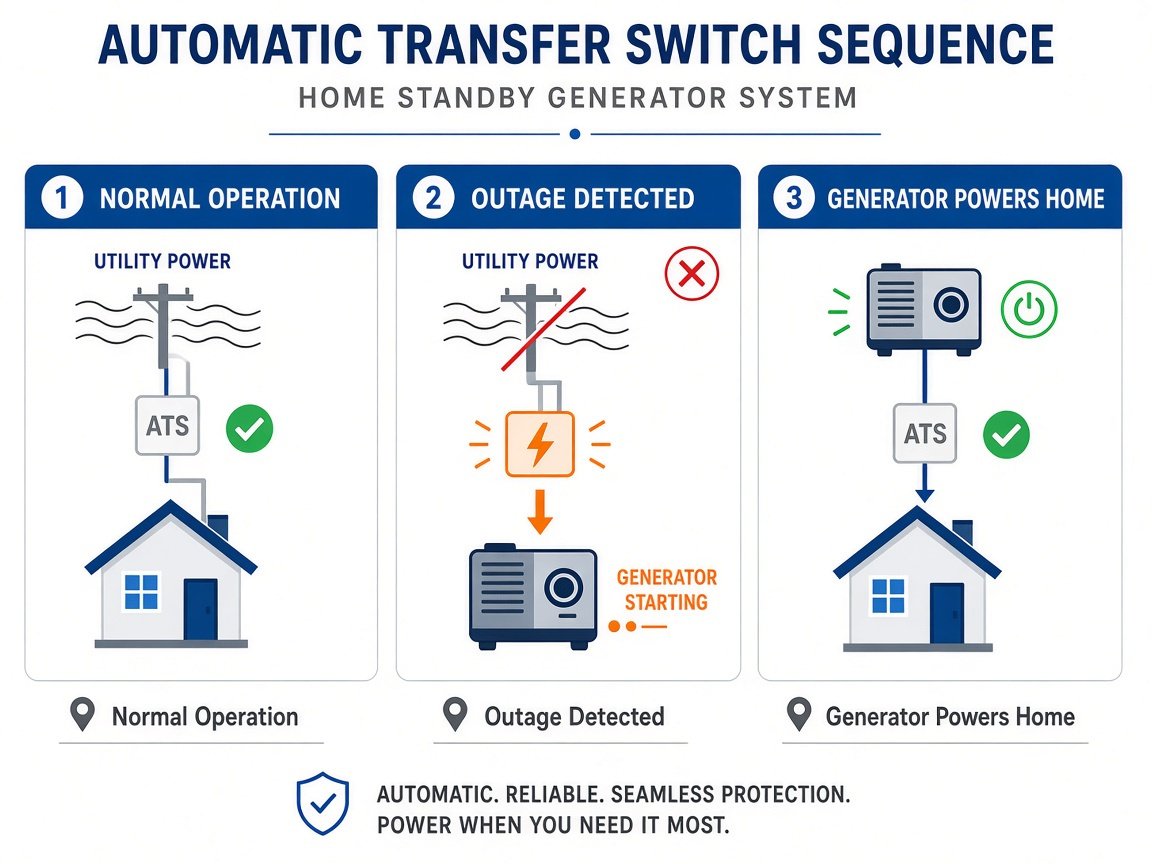
The automatic transfer switch (ATS) is the component that makes a standby generator different from a portable unit. The ATS monitors incoming utility voltage around the clock. When that voltage drops or disappears, it signals the generator to start, then opens the utility supply connection and closes the generator connection — restoring power to your home’s circuits. When utility power returns, the ATS reverses the process and the generator shuts down automatically. No extension cords, no fuel runs, no manual intervention.
Because the generator draws from your natural gas main or a fixed LP tank rather than a portable fuel container, it does not require refuelling during an outage. For homes in regions where grid outages are frequent, extended, or coincide with conditions that make leaving the house difficult — severe winter storms, flooding, ice events — this degree of automation is the defining advantage of a whole-house standby system over any portable alternative.
What Size Kohler Generator Does Your Home Actually Need?
Sizing is the most consequential decision in this purchase. A generator that is too small trips on overload the first time the HVAC compressor cycles on. One that is too large wastes capital, runs at inefficient light loads, and adds unnecessary installation cost. Getting the number right requires understanding starting watts — not just running watts.
Motor loads are the key variable. Well pumps, central air conditioning compressors, and refrigerators all draw surge currents on startup that can be two to three times their steady running draw. Any sizing exercise that ignores surge demand will underestimate the required capacity. The correct approach is to list every circuit you want backed up, find the starting wattage of each motor-driven load, and add up the worst-case simultaneous demand.
To illustrate: a home with a 3-ton central air conditioning unit, a well pump, a refrigerator, and general lighting and outlets could have a combined starting load that easily exceeds 13,000 watts depending on equipment age and compressor type. This illustrative scenario indicates a 14kW minimum — and explains why the 20kW RESA is the most common whole-home choice for mid-size houses. Kohler’s residential RESA air-cooled series covers three practical tiers:
- 8kW–12kW: essential circuits — lighting, refrigeration, well pump, select small appliances. Suited to smaller homes or a deliberate partial-home backup strategy where you protect a prioritised subset of circuits.
- 14kW–17kW: whole-home coverage for a mid-size house without central air conditioning, or partial whole-home backup that includes one HVAC zone.
- 20kW and above: whole-home coverage including central HVAC for most mid-size single-family homes. Larger properties or homes with significant simultaneous motor loads will likely need a liquid-cooled model starting at 24kW.
If you are weighing whole-home backup against a more selective approach, Generator Junkie’s guide to partial home generators explains how protecting only essential circuits works and when it makes better financial sense than a full standby system.
Which Kohler Whole House Generator Models Are Available?
Kohler’s residential standby lineup divides into two engine cooling types. The correct choice depends primarily on how much output capacity you need and your overall budget.
Air-Cooled RESA Series (8kW–20kW)
The RESA (Residential Standby Aluminum) series is Kohler’s core residential offering. It covers six models — 8RESA, 10RESA, 12RESA, 14RESA, 17RESA, and 20RESA — using Kohler-designed and manufactured air-cooled engines housed in corrosion-resistant aluminium enclosures. That aluminium housing is a documented design feature noted in Kohler Power product documentation as engineered to resist corrosion, which is a genuine advantage in coastal, high-humidity, and salt-air environments where competing steel-enclosure units require more active upkeep.
All RESA models include Kohler’s OneTEST feature, which automatically runs a brief unloaded exercise cycle on a user-configurable schedule — typically weekly — to keep the battery charged and the engine lubricated, according to Kohler Power product documentation. Confirm whether the automatic transfer switch is bundled with the unit or priced separately before comparing dealer quotes.
Liquid-Cooled Series (24kW and Above)
For larger homes, properties with heavy combined HVAC and appliance loads, or light commercial applications requiring more than 20kW of continuous standby capacity, Kohler’s liquid-cooled residential models start at 24kW. Liquid cooling enables higher sustained output, longer continuous duty cycles, and — under heavy load — quieter operation than an air-cooled engine of comparable rated output. These units are physically larger, require a more substantial concrete pad, and carry a higher purchase and installation cost. They are the appropriate choice when 20kW of air-cooled capacity is not enough for your home’s requirements.
How Does a Kohler Standby Generator Operate During a Power Outage?
The startup and power restoration sequence is fully automatic. Every step below occurs without any input from the homeowner — which is the entire point of a permanently installed standby system.
- Outage detection: the automatic transfer switch monitors incoming utility voltage continuously. When voltage falls outside acceptable limits, it signals the generator’s control board to initiate a start sequence.
- Engine startup: the starter motor cranks the engine. Kohler residential RESA models are designed to reach stable operating speed within seconds of the start signal.
- Voltage and frequency verification: the generator’s output is confirmed at 120/240V, 60Hz before the transfer switch operates, ensuring correct voltage is present before your home’s circuits are connected.
- Load transfer: the ATS opens the utility supply connection and closes the generator supply connection. Your home’s circuits are now powered by the generator.
- Sustained operation: the control board monitors engine oil pressure, coolant temperature (on liquid-cooled models), and output quality in real time. A protective fault condition triggers automatic shutdown to prevent engine damage.
- Utility restoration and cooldown: when stable grid power returns, the ATS verifies utility voltage quality, transfers the load back to the grid, and signals the generator to complete a brief cooldown period before shutting off.
Many current Kohler residential models also include connectivity for remote monitoring via a mobile application or web portal, allowing homeowners to receive fault notifications, review exercise history, and confirm generator status without a physical inspection of the unit.
What Does a Kohler Whole House Generator Cost?
The total project cost has two main components — the generator unit and the installation — and most buyers significantly underestimate the second number when they begin their research.
Generator Unit Cost
Kohler generators are sold exclusively through authorised dealers, not through big-box retailers or direct to the public. Dealer pricing varies by region, and the same model can carry meaningfully different prices in different markets. Smaller air-cooled RESA models cost considerably less than larger air-cooled or liquid-cooled alternatives. Whether the automatic transfer switch is bundled with the generator package or priced separately also affects the upfront unit cost — always confirm what is included before comparing quotes from different dealers.
Installation Cost
Installation encompasses a concrete pad, electrical panel work, ATS installation, gas supply extension, grounding, permits, and labour from licensed electrical and gas contractors. Site-specific factors — how far the generator must be located from the home, whether the existing gas supply line has adequate capacity for the generator’s BTU demand, local permit fees, and the complexity of the panel connection — can shift the installation cost significantly from one property to the next. For a complete line-by-line breakdown of what drives the installed price of a whole-house standby generator, Generator Junkie’s guide to home generator installation costs covers every variable in detail.
How Is a Kohler Whole House Generator Installed?
Kohler standby generator installation is not a DIY project. It requires a licensed electrician for the panel and transfer switch connections, a licensed gas plumber for the fuel supply extension, and in most jurisdictions a building permit. Kohler requires installation by an authorised dealer to maintain warranty coverage.
- Site selection: the generator location must satisfy Kohler’s published clearance requirements and local code minimums, including distances from windows, doors, gas meters, utility entrances, and property lines. Your dealer will confirm the applicable rules for your jurisdiction during the proposal stage.
- Concrete pad: a level concrete pad is installed to support the generator’s weight and prevent frost heave or differential settling over the unit’s service life.
- Automatic transfer switch installation: the ATS is mounted at or adjacent to the main electrical panel and wired to both the incoming utility feed and the generator output cable.
- Gas supply extension: a licensed gas plumber extends the home’s natural gas main or LP supply line to the generator location, with pipe diameter sized to meet the generator’s full-load BTU demand without pressure drop.
- Generator placement and interconnect wiring: the unit is placed on the pad, connected to the transfer switch via rated cable, and bonded to the home’s grounding system.
- Commissioning: the dealer performs a full functional test, programs the ATS, sets the weekly exercise schedule, and confirms all fault monitoring and protective shutdown functions are active.
For a deeper look at the electrical principles behind connecting a standby generator to a home’s panel — including transfer switch types and panel connection methods — the Generator Junkie guide to safely wiring a generator to your house covers the relevant code requirements in detail.
What Fuel Does a Kohler Whole House Generator Run On?
Kohler residential standby generators are designed to operate on natural gas or liquid propane. The same platform supports both fuel types; configuration is set at installation, and conversion kits are available for switching if your fuel supply situation changes after the unit is in service.
Natural Gas
Natural gas is the preferred fuel for urban and suburban installations where a utility gas main is available. Supply arrives through the utility’s pipeline infrastructure, eliminating the need for on-site fuel storage and removing the risk of running dry during a normal extended outage. The generator connects to the home’s gas meter via a dedicated supply line sized by a licensed gas plumber. The primary limitations are geographic — natural gas is not available everywhere — and systemic: wide-area emergencies that disrupt gas distribution can reduce supply pressure when regional demand spikes simultaneously.
Liquid Propane (LP)
LP suits rural properties and locations without natural gas service. Fuel is stored in an above-ground or underground tank sized for the anticipated run time at the property’s expected load level. Starting any outage with adequate fuel in the tank is the primary operational discipline — a generator connected to an empty LP tank provides no backup whatsoever. Understanding exactly how your load level affects fuel consumption is essential for sizing the tank and planning refill schedules. Generator Junkie’s breakdown of fuel consumption rates and how to maximise generator run times provides the framework for making that calculation accurately.
How Does Kohler Compare to Generac, Cummins, and Other Standby Generator Brands?
Generac holds the largest share of the North American residential standby generator market. Kohler, Cummins (sold under the Quiet Connect brand), and Champion also compete in this segment. Understanding the key differences helps clarify whether Kohler’s specific strengths align with what matters most to you.
| Factor | Kohler | Generac | Cummins Quiet Connect |
|---|---|---|---|
| Engine source | Kohler-built (vertically integrated) | Generac-built | Cummins-built |
| Air-cooled residential range | 8kW–20kW (RESA series) | 7kW–22kW (Guardian series) | 13kW–20kW (select models) |
| Enclosure material | Corrosion-resistant aluminium | Steel (most residential models) | Composite |
| Residential warranty | 5-year limited (per Kohler Power documentation) | 5-year limited | 5-year limited (confirm with dealer) |
| Distribution channel | Authorised dealers only | Dealers and major home improvement retailers | Authorised dealers only |
| Market position | Premium residential and commercial | Market-share leader, residential-focused | Premium, marketed on quiet operation |
The most practically significant difference for most buyers is distribution. Generac generators are available through Home Depot and similar outlets in many markets, while Kohler and Cummins require going through a certified dealer. This affects installation network density, pricing negotiation leverage, and post-sale service relationships. For a detailed look at how Generac’s pricing stacks up as a market reference point, Generator Junkie’s guide to Generac generator costs breaks down every cost variable in the same format used here.
What Routine Maintenance Does a Kohler Whole House Generator Require?
A standby generator sits idle for most of its service life but must be ready to fire at full load the moment the grid fails. Maintenance protocols exist to ensure that readiness. Kohler specifies service intervals in each model’s owner’s manual; authorised dealers can perform scheduled maintenance and document it for warranty purposes.
Automatic Weekly Exercise
Kohler residential models run an automatic unloaded exercise cycle on a configurable weekly schedule. This keeps the battery charged, lubricates internal seals, circulates engine oil, and verifies the startup sequence. If the unit skips multiple consecutive exercise cycles without successfully completing a start, investigate the cause before relying on the generator during an outage — a unit that won’t exercise reliably may not start when it is actually needed.
Annual Service Tasks
- Oil and filter change, per Kohler’s specified interval or annually — whichever comes first
- Air filter inspection; replacement as needed
- Spark plug inspection; replacement at manufacturer-specified intervals
- Battery load test; replacement if capacity is degraded
- Coolant level and condition check on liquid-cooled models
- Automatic transfer switch contact inspection
- Visual inspection of all wiring connections, the gas line connection, and the enclosure for signs of wear, rodent activity, or moisture ingress
Seasonal Preparation
Battery condition is the single most common cause of standby generator no-start failures in cold weather. Low temperatures reduce battery capacity and increase engine cranking resistance simultaneously. Replacing a battery that is more than three to four years old before the start of winter — rather than waiting for a failure — is inexpensive insurance against an outage failure on the coldest night of the year, when demand on your generator is highest and the consequences of a no-start are most severe.
What Are Common Kohler Generator Problems Owners Report?
The failure modes below reflect patterns reported by Kohler residential generator owners in online forums, installer communities, and product review platforms. They are not unique to Kohler — the same patterns occur across all standby generator brands — but knowing them in advance allows for faster diagnosis when they arise.
- Failure to start after battery degradation: a weakened battery cannot reliably crank the engine, particularly in cold weather. This is the most preventable single-point failure in any standby generator system. Regular battery testing and proactive replacement on a schedule are the best mitigation.
- Low oil pressure shutdown: Kohler’s engine protection system shuts down automatically when oil pressure falls below a safe threshold. Triggers include a genuine low-oil condition, a slow oil leak, or a sensor fault. Checking the oil level is always the first diagnostic step; if level is correct, a sensor or oil pump fault may be present.
- Nuisance fault codes: control board fault codes can originate from a real mechanical fault or from a transient sensor event. Owners report that some codes during initial operation or after extended idle periods clear after a few normal exercise cycles. Codes that persist or recur warrant a dealer inspection.
- Transfer switch faults: the ATS is a separate electromechanical component subject to contactor wear and connection loosening over time. Transfer failures — where the generator runs but power is not restored to the house — typically originate in the ATS rather than the generator itself.
- Governor hunting at light load: some air-cooled models exhibit engine speed fluctuation when running at very low loads, particularly when first started in cold conditions. This typically resolves as the engine reaches operating temperature; persistent hunting warrants a dealer service call to assess the carburettor and governor.
For a comprehensive reference covering eleven standby and portable generator fault patterns with diagnostic guidance for each, Generator Junkie’s guide to common generator problems and how to respond is a useful resource to bookmark alongside your Kohler owner’s manual.
Frequently Asked Questions About Kohler Whole House Generators
How long can a Kohler whole house generator run continuously?
A Kohler standby generator can run as long as fuel is available. On natural gas connected to a utility main, supply is effectively unlimited during a normal grid outage. On LP, run time is determined by tank size and generator load level. Kohler publishes fuel consumption specifications for each residential model, allowing you to calculate expected run time against your tank capacity at your anticipated load.
Can a Kohler whole house generator run central air conditioning?
Yes, provided the generator is sized appropriately for the HVAC system’s starting current requirements. A 20kW RESA is the typical minimum recommendation for whole-home backup that includes a central air conditioning system, but the correct size depends on your specific HVAC unit’s nameplate ratings and the total simultaneous demand from all backed-up circuits. A load calculation performed by your installing dealer is the definitive sizing method — a rule of thumb is a starting point, not a final answer.
How far from the house must a Kohler generator be installed?
Kohler specifies minimum clearance distances from windows, doors, gas meters, utility entrances, and property lines in each model’s installation manual. Local building codes and fire ordinances add further requirements on top of Kohler’s own minimums. Your authorised dealer will confirm the applicable siting rules for your specific jurisdiction — required distances vary meaningfully between municipalities and code adoption cycles.
Does a Kohler standby generator have to be installed by a dealer?
Yes, for two reasons. Kohler requires installation by an authorised dealer to maintain warranty coverage. Separately, the work itself — transfer switch wiring, panel connections, and gas supply extension — requires licensed electricians and gas contractors under virtually all North American building codes regardless of the generator brand. Dealer installation is both a warranty condition and a regulatory necessity.
What automatic transfer switch does a Kohler standby generator use?
Kohler manufactures its own RXT series automatic transfer switches, designed and rated to work with its standby generators. They are available in amperage ratings matched to common home electrical service sizes. Transfer switches are sometimes bundled in generator packages and sometimes priced separately — confirming what is included is an important step when comparing dealer quotes.
How noisy is a Kohler whole house generator during operation?
Noise levels vary by model and load level. Kohler publishes decibel ratings for each residential model in its product specifications. Air-cooled RESA models are generally rated in the low-to-mid 60s dB(A) at a standard measurement distance — broadly comparable to a normal conversation at close range. Liquid-cooled models tend to operate more quietly at high loads. All standby generators are audible during operation; local noise ordinances and proximity to neighbouring properties are worth reviewing during the site selection stage.
What happens if a Kohler generator runs out of fuel during an outage?
The engine shuts down automatically to prevent damage. On natural gas, running out of supply during an outage is uncommon under normal conditions but can occur during wide-area gas infrastructure emergencies. On LP, tank depletion is the primary risk and is entirely preventable through regular monitoring and proactive refills. When fuel supply is restored or the LP tank is refilled, the generator will attempt to restart automatically.
Conclusion: Is a Kohler Whole House Generator the Right Investment?
A Kohler whole house generator is a well-engineered permanent backup power solution with a clearly defined value proposition: automatic, whole-home power restoration during grid outages, backed by a vertically integrated engine supply chain, a corrosion-resistant aluminium enclosure, and a 5-year limited warranty supported by an authorised dealer network. For homeowners in coastal environments, areas with frequent severe weather outages, or properties with medical equipment or other power-critical needs, Kohler’s product attributes align directly with the requirements of the application.
Looking ahead over the next twelve to twenty-four months, the residential standby market is moving steadily toward greater connectivity and integration with home energy management systems. Battery storage paired with standby generators — using the battery to cover short outages silently while the generator handles extended events — is a growing configuration. Buyers investing in a Kohler unit in 2026 should confirm with their dealer that the model they select includes remote monitoring capability and ask about available integration pathways with home battery systems if that is a future priority. Connected models are more likely to receive firmware updates that extend their feature set over time.
Your Actionable Next Steps
- Calculate your load: list every circuit you want backed up, find the starting wattage of each motor-driven load — particularly the AC compressor and well pump — and establish your peak simultaneous demand. This number sets your minimum generator size.
- Confirm your fuel supply: verify whether your property has natural gas service with sufficient line capacity for the generator’s BTU demand, or whether LP will be required. If LP, identify a tank location and size it for your anticipated outage duration at your expected load level.
- Request fully itemised dealer quotes: contact at least two authorised Kohler dealers. Ask each to quote the generator unit, transfer switch, concrete pad, gas supply work, electrical labour, permits, and commissioning as separate line items — not as a single installed price.
- Compare with at least one alternative: obtain a parallel quote for an equivalent Generac unit. The installed cost difference in your local market may be decisive — or it may not justify switching brands.
- Budget for ongoing maintenance: plan for annual authorised dealer service. A correctly installed Kohler generator that receives regular maintenance is designed to deliver fifteen or more years of reliable service. One that is neglected is a liability, not an asset.